

30 Weird Laws in Germany That Will Genuinely Surprise You
Weird laws in Germany are not urban myths. They are real, enforced, and sometimes genuinely hard to believe. A pillow counts as a weapon. Running out of fuel on the Autobahn is negligence. Dancing on Good Friday can cost you €10,000. Whether you are visiting, relocating, or just curious about how a country this organized ended up with rules this strange, this list covers 30 of them, ranked honestly from head-scratching to surprisingly reasonable.
Germany runs on structure. Most of its laws exist for clear reasons. But a handful sit in a category of their own, where the rule is technically logical yet completely unexpected to anyone who did not grow up here. Tourists get caught out by Sunday store closures. Expats get fined for sorting recycling wrong. First-time visitors address a police officer too casually and suddenly have a problem. Knowing what to expect changes the experience entirely.
Genuinely Bizarre Laws in Germany
These have no immediate defense. They exist, they are enforceable, and they will make you re-read the sentence twice.
A Pillow Can Be Classified as a Weapon
In domestic disputes, any object used to harm someone physically, regardless of how soft, can be treated as a passive weapon. Hit someone with a pillow and face an assault charge.
Driving Naked is Legal (If You Stay in the Car)
You are free to drive completely without clothes in Germany. The moment you step outside the vehicle, the law has a different opinion. As long as you stay seated, nothing applies.
Running Out of Fuel on the Autobahn is Illegal
Germany considers running dry on the motorway as personal negligence. You passed the petrol stations. The law does not accept that as an accident. Fine: up to €70 plus towing costs on top.
Traveler tip: If you are renting a car and planning long drives, do not assume you will find a station in time. Fill up early, especially on less-trafficked stretches.
A Marriage is Invalid If One Partner Did Not Know It Was a Wedding
Written into the German Civil Code. If one spouse was unaware the event they attended was a wedding ceremony, the marriage can be legally dissolved. Someone, at some point, clearly needed this rule.
Beekeepers Can Legally Trespass on Private Property
If a swarm escapes, the beekeeper has the legal right to enter any private land to recapture it. They must pursue immediately. If they delay, they lose legal ownership of the bees entirely.
Marching in Unison on a Bridge is Banned
In 1831, a regiment of British soldiers marched in step across a bridge and caused it to resonate and collapse. Germany wrote this into law. Whether two people walking at the same pace counts is legally untested.
Drumming in an Apartment Has a Legal Time Cap
45 minutes per day in summer. 90 minutes in winter. Piano players get two hours. This is not a building rule your landlord made up. It was ruled on by the Federal High Court of Justice.
Expat note: If you play an instrument and rent in Germany, check quiet hours carefully. Your neighbours know the rules better than you do.
Hoverboards Are Illegal on Public Roads
Classified legally as motor vehicles, hoverboards and e-skateboards cannot meet road standards for registration or insurance. They have been banned from public roads since 2020. No workaround exists.
Dancing on Good Friday is Banned and Fined Heavily
On certain public holidays including Good Friday, public dancing is prohibited. In Bavaria, sports events and live music are also banned on these days. Breaking this rule carries a fine of up to €10,000. Private parties are allowed, but must stay quiet. If you are planning to visit around Oktoberfest or other festivals, check the holiday calendar carefully since dates can overlap.
Traveler tip: If you are booking a club night or concert in Germany around Easter, verify the date. Several venues have been fined for ignoring this.
Monty Python's Life of Brian is Banned in Cinemas on Certain Holidays
Several German states prohibit screenings of films deemed religiously offensive on protected public holidays. The Life of Brian sits on that list. The ban applies specifically to cinema screenings, not home viewing.
Weird Laws in Germany That Actually Have a Reason
These still surprise most people. But once you know the logic, you will at least understand why Germany went there.
No lawn mowing on Sundays
Sundays are legally protected rest days (Ruhetag). Mowing, drilling, hammering, and vacuuming are all restricted. Your neighbours will report you without hesitation.
Noise protection law. Germany treats Sunday rest as a public right, not a personal preference.
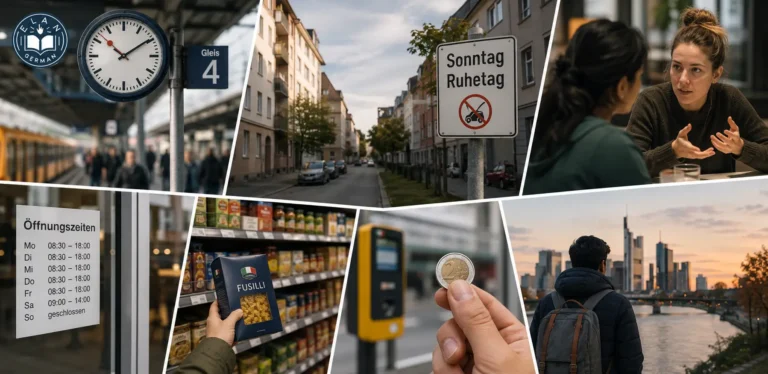
All shops close on Sundays
Not a tradition. Actual law. Supermarkets, pharmacies (except on-call), clothing stores, electronics, all of it. Tourists discover this the hard way. If you are visiting Berlin, plan your week around it using a Berlin itinerary so Sunday does not catch you off guard.
Worker protection and the same Ruhetag principle. Retailers have lobbied against it for years. The law has not moved.
Washing your car at home is illegal
In most German municipalities, washing a car on a private driveway or street is banned. Soap, oil residue, and cleaning chemicals cannot legally enter public drainage systems.
Environmental protection. Groundwater contamination is taken seriously. Designated car wash points handle the drainage properly.
Cycling drunk can cost you your driving licence
German law covers all road use, not just cars. If caught cycling above the legal blood alcohol limit, you can lose your driving licence even if you do not own a vehicle. The same applies to e-scooters. After a night out, the German public transport system is genuinely the safer call.
Traveler tip: Many tourists assume cycling drunk is a loophole. It is not. Officers do stop cyclists and test them.
Road safety law applies to all vehicles. A drunk cyclist is a danger to pedestrians and other road users.
Addressing a police officer as "du" is an offence
German has two forms of "you." Du is informal. Sie is formal. Using du with a police officer is considered an insult under public insult laws (Beleidigung). It can result in an on-the-spot fine.
Anti-insult legislation. Germany takes verbal disrespect toward officials seriously. The informal form signals deliberate rudeness in this context.
You cannot keep a loved one's ashes at home
Friedhofszwang, or cemetery obligation, requires all human remains to be interred in a designated burial site. An urn on your mantelpiece is not permitted. Burial at sea is the only legal alternative.
Originally a hygiene regulation. It also ensures remains are treated with legal dignity and reduces disputes over inheritance of ashes.
Dog owners must walk their dogs twice a day
Since 2021, German law requires pet owners to walk dogs at least twice daily for a combined minimum of one hour. Keeping a dog permanently in a flat without outdoor access is a legal violation, not just frowned upon.
Expat note: If you are planning to get a dog after relocating, factor this into your schedule before committing. It is legally binding.
Animal welfare legislation. Germany has some of the strictest animal protection laws in the EU.
Offices must legally have windows with a view of the sky
Every German workplace must provide employees with access to natural daylight. At minimum, there must be a window through which workers can see the sky. Underground offices require special exemptions.
Worker health protection. Research links natural light to productivity and mental health. Germany legislated it rather than leaving it to employers.
Incorrect recycling is a finable offence
Germany operates one of the most detailed recycling systems in the world, with separate bins for paper, glass by colour, packaging, and general waste. Sorting incorrectly is not just frowned upon. Neighbours report it and building managers enforce it. Read up on how the German recycling system works before your first bin day.
Expat note: This is one of the most common mistakes new arrivals make in their first week. The bin colours and categories vary slightly by city, so check locally.
Environmental law. Germany's recycling targets are set at EU level and enforced at municipal level.
Jaywalking is illegal and actively fined
Crossing on a red pedestrian signal is illegal in Germany, including at 3am on an empty road. Police do fine people for it. More practically, crossing on red in front of a child can result in a higher fine as it sets a bad example.
Road safety and social norm enforcement. Germans treat the pedestrian signal seriously. Ignoring it marks you immediately as a tourist.

Ready to Test Your German Skills?
Take our free German A1 test online and see where you stand. Get instant results and know exactly what to practice next.
Start Free A1 TestAlso check: How to Pass Goethe A1 Exam
Social Rules That Function as Laws
Nothing in writing. Fully enforced. Break these and you will know immediately from the reaction around you. These are the rules that catch most newcomers off guard. If you want to avoid the most common slip-ups, the guide on beginner German mistakes covers many of these in more detail.
Never wish someone a happy birthday early
Wishing someone happy birthday before the actual day is considered bad luck in Germany. Germans mean this. Do not do it as a joke. You will get a serious look in return.
Deeply held superstitionDoors stay closed — always
In German offices and apartment hallways, doors are kept shut by default. An open door signals that something needs attention. Leaving yours open is read as an invitation for interruption, which nobody wants.
Office + apartment cultureOn time means five minutes early
Arriving exactly on time is acceptable but borderline. Five minutes early is normal. Five minutes late requires an explanation. Ten minutes late with no message is a social offence that people remember.
Professional + social settingsTraveler tip: This applies to dinner invitations, viewings, and appointments equally. If you are running late, a quick message goes a long way.
First names are not yours to use until offered
In professional settings, and often with neighbours, Germans use titles and surnames until someone explicitly invites you to use their first name. Jumping straight to first names reads as presumptuous, not friendly.
Workplace + formal settingsWalk on the correct side or prepare for impact
Germans walk on the right side of pavements, escalators, and corridors. If you wander into oncoming foot traffic, nobody will reroute around you. They will walk directly into you, make eye contact, and keep moving.
Universal in citiesRules Other Countries Should Honestly Copy
These look odd on paper but hold up completely once you think about them. Several countries would benefit from borrowing at least a few of these.
16-year-olds can legally buy and drink beer and wine
Along with Belgium and Denmark, Germany allows 16-year-olds to purchase and consume beer and wine without a parent present. Spirits require you to be 18. The reasoning is that moderate drinking with proper social context is healthier than total prohibition followed by binge drinking at 18.
Legal since decadesLarge stretches of the Autobahn have no speed limit
The recommended speed is 130 km/h. There is no legal cap on designated sections. This works partly because the driving test in Germany is expensive, rigorous, and taken seriously. Drivers who pass it are genuinely trained for high-speed motorway driving.
Designated sections onlyTraveler tip: If you are renting a car, check your rental agreement. Many rental companies impose a maximum speed cap regardless of what the road allows.
Drinking alcohol in public is completely legal
A beer on a park bench, at a train station, or walking down the street is entirely legal and socially normal. Local laws can restrict it in specific zones, but broadly Germany treats adults as capable of drinking outdoors without causing problems. The German Christmas markets are a perfect example, where mulled wine is handed to you on the street as a matter of course.
Broadly legal nationwideTenant protection is among the strongest in Europe
Landlords cannot evict tenants without a legally documented reason. The process takes months at minimum. Rent increases are capped in many cities. Security deposits are capped at three months rent. For anyone relocating long-term, this is one of the more practical protections you will encounter. It is worth reading about living expenses in Germany before signing anything.
Legally enforcedThe Beer Purity Law has been enforced since 1516
Reinheitsgebot states that Bavarian beer can only contain water, barley, hops, and yeast. No additives, preservatives, or substitutes. Duke Wilhelm IV introduced it in 1516 and over 1,300 German breweries still follow it today. If you want to understand what this law tastes like in practice, the section on traditional German food and drink covers the full picture.
In force since 1516Scenarios Travellers Actually Face in Germany
These are not hypothetical. Every one of these has caught out a tourist or a new arrival at least once. Here is what actually happens and what to do.
You run out of fuel on the Autobahn
You are driving a rental car between cities, misjudge the distance, and the tank hits empty. You pull over onto the hard shoulder and put on the hazard lights. Seems reasonable.
The police can fine you up to €70 for stopping on the Autobahn due to a preventable reason. Running out of fuel is classified as negligence since you passed multiple petrol stations. The car also gets towed, which adds considerably to the cost. The fine goes on your record at the Flensburg traffic database if you hold a German licence.
Fill up when the tank hits a quarter. Do not rely on the low fuel warning on the Autobahn. There is no minimum distance between stations and some stretches are long.
You land on a Sunday and need groceries
You arrive in Germany on a Sunday afternoon. Your Airbnb has nothing in it. You head to the nearest supermarket, then the next one, then start looking for a corner shop. All closed.
Almost everything is shut. Supermarkets, pharmacies except on-call ones, clothing shops, electronics stores. The law does not distinguish between cities or tourist areas. A handful of exceptions exist: shops inside major train stations (Hauptbahnhof) are permitted to open on Sundays. Petrol stations can sell basic items. Bakeries may open for a few hours in the morning.
If you are arriving on a Sunday, stock up on Saturday. Otherwise, head to the central train station. Most major cities have one with a supermarket inside that trades on Sundays legally.
You cycle home after a few drinks
You left the car at home specifically to be responsible. After a few beers at a bar you decide cycling back is the sensible option. You are stopped at a police check near the city centre.
German road law applies to all vehicles, not just cars. Above 1.6 per mille blood alcohol you can lose your driving licence even if you have never driven a car in your life. Between 0.3 and 1.6 per mille, officers can still take action if your riding is visibly impaired. E-scooters follow the same rules as cars with a 0.5 per mille limit. After a big night out, the German public transport system runs late and is genuinely reliable.
Take the U-Bahn or a night bus. Most German cities run reduced but functional public transport through the night on weekends. It is cheaper than the fine and considerably cheaper than losing a licence.
You start drilling or vacuuming on a Sunday morning
You are staying in an Airbnb or a short-term rental. Sunday morning, you want to sort out a loose shelf or run the hoover before guests arrive. It is only 10am.
Noise from drilling, vacuuming, or any kind of home maintenance on a Sunday is prohibited under Ruhetag laws. A neighbour complaint can result in the building manager or police being called. Most Germans know the rules and will not hesitate to knock on your door or call the building contact. In some buildings this extends to Saturday afternoons as well depending on house rules.
Save any noisy tasks for weekday mornings or Saturday before 1pm. If you are unsure about specific hours in your building, check the Hausordnung, the house rules posted near the entrance or letterboxes.
You put something in the wrong bin
You are staying in a shared building. There are four bins in the courtyard in different colours. You are not sure which is which, pick the most likely looking one, and drop your rubbish in.
The waste management company can reject an entire bin collection if it is contaminated with incorrect items. The cost of rejected collections is often passed back to the building. Your building manager will find out, and neighbours in Germany pay close attention to the bins. It is a reliable way to get off on the wrong foot quickly. The German recycling system is more detailed than most countries and is worth reading before your first bin day.
Yellow bin is for packaging with the green dot symbol. Blue is paper. Brown is organic waste. Black or grey is general residual waste. Glass goes in separate outdoor containers sorted by colour. When in doubt, residual waste bin is the safest choice.
You book a club night that falls on Good Friday
You are visiting Germany around Easter. You find a club event, book tickets, and plan your evening. You arrive to find the venue closed or the event cancelled with no warning given.
Public dancing is banned on Good Friday across Germany. In Bavaria the restrictions go further, covering live music and sports events. Venues that ignore this face fines of up to €10,000. Many cancel events without proactively notifying ticket holders, leaving attendees outside with no recourse. If you are planning a trip around the Oktoberfest season or other festival periods, check whether any dates fall on restricted public holidays.
Check the German public holiday calendar before booking any events. Good Friday, All Saints Day, and the Sunday of the Dead all carry restrictions. Private parties at home are generally fine, just keep the volume down.
You cross on a red light at an empty road
It is early morning, no cars in sight, and you cross on a red pedestrian light out of habit. A plain-clothes officer nearby watches the whole thing. There is a child waiting at the same crossing.
Standard fine for jaywalking is between €5 and €10. Crossing on red in front of a child increases the fine because it constitutes setting a bad example under German road law. Officers do enforce this, particularly in city centres, and plain-clothes checks near schools and busy crossings are not uncommon.
Wait for the green. It is genuinely that simple. Germans notice and they will say something even if no officer is present. The social discomfort is arguably worse than the fine.
FAQ: 30 Weird Laws in Germany That Will Genuinely Surprise You
What are the most bizarre weird laws in Germany that tourists should know about?
The ones that catch people most off guard are the Sunday trading ban (all shops closed by law), the rule that running out of fuel on the Autobahn is considered negligence and is punishable, the ban on public dancing on Good Friday with fines up to €10,000, and the legal requirement that all human remains must be buried in a cemetery. You cannot keep a loved one’s ashes at home. These are not outdated rules sitting forgotten in a law book. They are actively enforced.
Is jaywalking actually illegal in Germany?
Yes, and it is enforced. Crossing a red pedestrian light is illegal regardless of whether any cars are present. The standard fine is between €5 and €10. If you cross on red in front of a child, the fine increases because German law treats it as setting a dangerous example. Plain-clothes officers do check this, particularly near city centres and schools.
Can you drink alcohol in public in Germany?
Yes. Drinking in public spaces is broadly legal across Germany and socially accepted. A beer on a park bench, at a train station, or while walking down the street raises no legal issue. Some cities have designated zones where it is restricted, but these are exceptions. Germany treats adults as capable of managing this without blanket prohibition.
What are Germany's Sunday laws and how do they affect visitors?
Sunday in Germany is legally protected as a rest day under Ruhetag laws. Shops, supermarkets, and most businesses are required by law to stay closed. Loud activities, including mowing, drilling, vacuuming, and DIY work, are prohibited. The main exception is shops inside major train stations, which are permitted to trade. Tourists arriving on a Sunday, expecting to buy groceries or supplies, regularly get caught off guard by this. Plan your shopping for Saturday.
Is cycling drunk illegal in Germany?
Yes, and the consequences go further than most people expect. German road law applies to all vehicles, not just cars. If you are caught cycling above the legal blood alcohol limit, you can have your driving licence suspended even if you do not own a car. E-scooters follow the same 0.5 per mille limit as cars. Many visitors assume cycling is a safe workaround after a night out. It is not.
What are the noise rules in Germany for apartments and rentals?
Quiet hours are taken seriously and are backed by law. Playing instruments is restricted to specific windows during the day, typically 8 am to noon and 2 pm to 8 pm. Drumming is capped at 45 minutes per day in summer and 90 minutes in winter by a Federal Court ruling. No drilling, hammering, or vacuuming is permitted on Sundays or late evenings. These are not just building policies your landlord invented. Many are grounded in national and state-level legislation.
Are there any German laws that are actually better than most countries?
Several. Tenant protection laws mean landlords cannot easily evict you, and rent increases are capped in many cities. Workers are legally guaranteed at least 20 paid vacation days per year. Every workplace must have windows with a view of the sky by law. Drinking in public is legal. Large sections of the Autobahn have no speed limit on designated stretches. The Beer Purity Law, dating back to 1516, still governs how Bavarian beer is brewed today. And 16-year-olds can legally buy beer and wine, which Germany treats as a healthier approach to alcohol education than outright prohibition until 18.
Discover more from Elan German
Subscribe to get the latest posts sent to your email.