German Public Transport Announcements and Signs Explained
German public transport announcements follow a predictable pattern everywhere: trains, buses, U-Bahn, S-Bahn, and airports all use the same core vocabulary. The words you must know are Gleis (platform), Verspätung (delay), Eingang and Ausgang (entry and exit), Abfahrt (departure), Ankunft (arrival), and Nächste Station (next stop). On trains you will hear things like Türen schließen, bitte zurücktreten (doors closing, please step back) and Ausstieg links (exit on the left). At airports, boarding calls follow a very formal structure. Once you learn these patterns, you can navigate any German city or airport without missing a beat. This post covers all of it, transport type by transport type, with full translation tables.
If you are new to the German transit system entirely, start with the German Public Transport Guide first. It covers ticketing, zones, and how the network is structured. Then come back here for the language side.
Train and Station Announcements
Germany runs several overlapping train services. ICE and IC long-distance trains are usually bilingual (German and English). Regional trains (RE, RB), S-Bahn, and U-Bahn run almost entirely in German. The good news: the announcement vocabulary is consistent. Once you know the phrases below, you will understand what is being said on any train in the country.

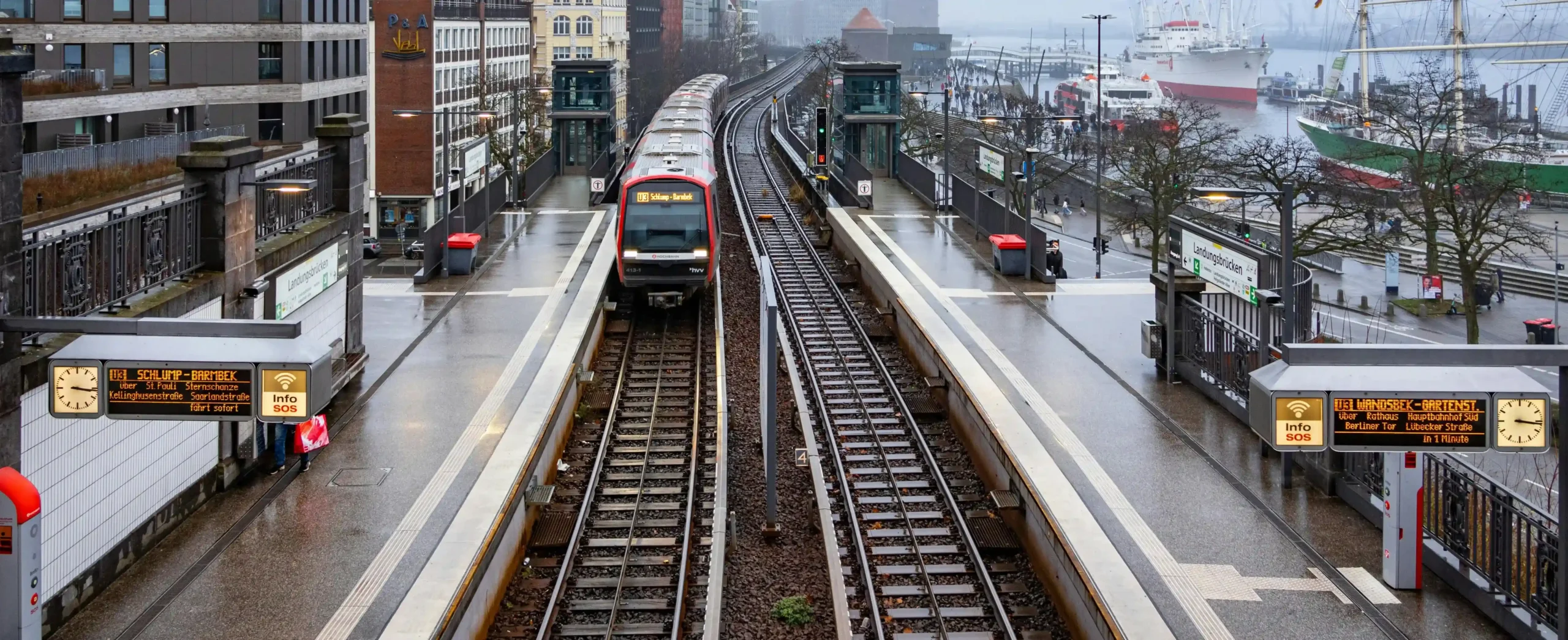
An Abfahrt (departure) board at a German train station.
What you will hear on trains
| German Announcement | English Translation | When you hear it |
|---|---|---|
| Nächste Station: [Name] | Next stop: [Name] | Before every stop |
| Türen schließen. Bitte zurücktreten. | Doors closing. Please step back. | Just before the train moves |
| Ausstieg in Fahrtrichtung links / rechts | Exit on the left / right (direction of travel) | Before arriving at a major station |
| Endstation [Name]. Bitte alle aussteigen. | Final stop [Name]. Everyone please exit. | Last stop on the line |
| Dieser Zug endet hier. Bitte alle aussteigen. | This train terminates here. Please exit. | Train not continuing further |
| Der Zug hat ca. [X] Minuten Verspätung. | The train is approximately [X] minutes late. | Delay update |
| Aufgrund einer Störung kommt es zu Verspätungen. | Due to a disruption, there are delays. | Technical or operational issue |
| Anschluss nach [Ort]: Gleis [X] | Connection to [Place]: Platform [X] | Info about your connecting train |
| Dieser Zug fährt weiter nach [Stadt]. | This train continues to [City]. | At a stop along the route |
| Bitte beachten Sie: dieser Zug hält nicht in [Station]. | Note: this train does not stop at [Station]. | Express or modified service |
| Bitte halten Sie Ihren Fahrschein bereit. | Please have your ticket ready. | Before ticket inspection |
| Achtung, Achtung. | Attention, attention. | Before any important announcement |
| Willkommen an Bord. | Welcome on board. | ICE and IC trains after departure |
Signs at train stations
German Bahnhöfe (train stations) use a consistent set of signs whether you are in Berlin, Munich, or a small regional town. Learn these once and you will never be lost at a station again.
| German Sign | English | What it means in practice |
|---|---|---|
| Gleis [X] | Track / Platform [X] | The numbered platform your train departs from |
| Bahnsteig | Platform | The physical area alongside the tracks where you board |
| Abfahrt | Departure | Departure board listing outgoing trains |
| Ankunft | Arrival | Arrival board listing incoming trains |
| Verspätung | Delay | Shown in orange or red on displays when your train is late |
| Umstieg / Umsteigen | Transfer / Change trains | You need to change to another service here |
| Fahrkartenautomat | Ticket machine | Self-service ticket purchase terminal |
| Reisezentrum | Travel center | DB service counter for tickets, seat reservations, and queries |
| Auskunft | Information | Help desk or information point |
| Wartesaal | Waiting room | Heated indoor waiting area, especially useful in winter |
| Gepäckaufbewahrung | Left luggage | Supervised storage for bags and luggage |
| Schließfächer | Lockers | Self-service coin or card-operated lockers |
| Eingang | Entrance | Way into the station or platform area |
| Ausgang | Exit | Way out of the station |
| Notausgang | Emergency exit | For emergencies only, always marked in green |
| Rolltreppe | Escalator | Moving stairs between levels |
| Aufzug | Elevator / Lift | Accessible vertical transport between floors |
| WC / Toiletten | Toilets | Restrooms, usually costs around €1 at larger stations |
Heading somewhere specific on the rail network? Check our German travel phrases post for on-the-go conversational help. If Berlin is your destination, things to do in Berlin is worth a read before you arrive.

Test Your German A1 Knowledge
Want to check how much German you actually know? Take the free A1 test online. It covers vocabulary, basic phrases, and transport-related language too. No signup needed.
Take the Free TestBus Announcements and Signs
City buses in Germany use automated announcement systems identical in style to S-Bahn and U-Bahn lines. In smaller towns or rural areas, some buses have no announcements at all, so keeping a transit app open (DB Navigator or Google Maps) helps. Bus stops carry more information than most people realize. Here is what to listen and look for.
What you will hear on buses
| German Announcement | English Translation | Context |
|---|---|---|
| Nächste Haltestelle: [Name] | Next stop: [Name] | Before every stop |
| Endstation. Bitte alle aussteigen. | Final stop. Everyone please exit. | Last stop on the route |
| Die Türen schließen. | The doors are closing. | Just before the bus moves |
| Bitte beim Aussteigen hinten aussteigen. | Please exit from the rear. | During busy periods |
| Bitte Fahrschein bereithalten. | Please have your ticket ready. | Before a ticket check |
| Bitte achten Sie auf Ihre persönlichen Gegenstände. | Please watch your personal belongings. | General safety reminder |
| Dieser Bus fährt weiter nach [Ort]. | This bus continues to [Place]. | Route continuation info |
| Bitte freihalten für Rollstuhlfahrer. | Please keep free for wheelchair users. | Near the front priority area |
| Umleitung. Der Bus fährt eine andere Route. | Detour. The bus is taking a different route. | Temporary route change |

A standard German Haltestelle (bus stop) yellow H sign
Bus stop signs
Every German bus stop has a yellow H sign on a pole. The pole or shelter displays the stop name, which lines stop there, where each line is heading, and the departure schedule. Here is what the labels mean.
| German Sign | English | What it means |
|---|---|---|
| Haltestelle | Stop | The bus or tram stops here |
| H (yellow sign on pole) | Bus stop marker | Standard identifier for all German bus stops |
| Linie [X] | Line [X] | The bus route number |
| Richtung [Ort] | Direction [Place] | Where this bus is heading (its final destination) |
| Fahrplan | Timetable | Full route schedule posted at the stop |
| Abfahrtszeiten | Departure times | When the next buses leave this stop |
| Bedarfshaltestelle | Request stop | The bus only stops here if you signal it or press the button |
| Umleitung | Diversion / Detour | Temporary route change, often posted on a paper notice |
Working on your German basics? The Basic German Greetings post is a solid starting point. For ready-to-use phrases when you are actually traveling, see German Travel Phrases.
Airport Announcements and Signs
German airports like Frankfurt (FRA), Munich (MUC), and Berlin Brandenburg (BER) make announcements in both German and English on international routes. On domestic German flights, expect German-first or German-only announcements. PA calls follow a strict pattern: the flight number, the destination, and the action required. Knowing the vocabulary helps you react fast, especially if your gate changes last minute.
What you will hear at German airports
| German Announcement | English Translation | When you hear it |
|---|---|---|
| Achtung, Achtung. Wir rufen Passagier [Name]... | Attention, attention. We are calling passenger [Name]... | Personal paging call |
| Flug [XX123] nach [Stadt] ist bereit zum Einsteigen. | Flight [XX123] to [City] is ready for boarding. | First boarding call at the gate |
| Wir bitten die Passagiere der Gruppe [X] zum Einsteigen. | We invite passengers of Group [X] to board. | Boarding by group or zone |
| Letzter Aufruf für Flug [XX123] nach [Stadt]. | Final call for flight [XX123] to [City]. | Last chance to board before gate closes |
| Bitte begeben Sie sich sofort zu Gate [X]. | Please proceed immediately to Gate [X]. | Urgent call, you are being waited on |
| Das Gate für Flug [XX123] wurde geändert zu Gate [X]. | The gate for flight [XX123] has been changed to Gate [X]. | Gate change announcement |
| Flug [XX123] nach [Stadt] hat Verspätung. | Flight [XX123] to [City] is delayed. | Flight delay notification |
| Bitte lassen Sie Ihr Gepäck nicht unbeaufsichtigt. | Please do not leave your luggage unattended. | Security reminder, heard throughout the terminal |
| Aus Sicherheitsgründen bitten wir Sie... | For security reasons, we ask you to... | Any security-related instruction |
German airport signs
Most international German airports bilingual their main signs, but smaller terminals and corridors are often German-only. These are the signs you will encounter from arrivals to departure gate.
| German Sign | English | Where you see it |
|---|---|---|
| Abflug / Abflughalle | Departure / Departures hall | Main direction signs on entering the airport |
| Ankunft / Ankunftshalle | Arrival / Arrivals hall | Where to go when meeting someone |
| Check-in | Check-in | Drop-off counters for bags and boarding passes |
| Sicherheitskontrolle | Security check | Security screening area before gates |
| Passkontrolle / Grenzkontrolle | Passport / Border control | After landing on international flights |
| Zoll | Customs | After passport control on international arrivals |
| Gepäckausgabe | Baggage claim | Where checked bags are collected |
| Gate [X] | Gate [X] | Your boarding gate |
| Terminal [X] | Terminal [X] | Which terminal building you need |
| Verbindungsgang | Connecting corridor | Walkway between terminals or piers |
| Ausgang | Exit | Way out of the building |
| Notausgang | Emergency exit | Emergency use only, always green |
| Rolltreppe / Aufzug | Escalator / Elevator | Between floors and terminals |
Quick tip: Gate changes are common at German airports, especially at Frankfurt and Munich. Always check the screens again after clearing security. Do not rely only on the boarding pass gate number.
Learn German From Scratch
The free German A1 book covers everything you need to get started: greetings, numbers, everyday vocabulary, and yes, transport language too. No cost, no signup, just download and learn.
Download the Free BookCommon Signs at a Glance

This is the full reference table. Every sign you are likely to encounter across German trains, buses, trams, and airports, sorted by category. Bookmark this or screenshot it before your next trip.
| German Sign | English | Category | Notes |
|---|---|---|---|
| Abfahrt | Departure | Navigation | Departure boards at stations and airports |
| Ankunft | Arrival | Navigation | Arrival boards at stations and airports |
| Eingang | Entrance | Navigation | Way into a building or platform area |
| Ausgang | Exit | Navigation | Way out of a building or area |
| Notausgang | Emergency exit | Safety | Always marked green, emergency use only |
| Gleis [X] | Track / Platform [X] | Navigation | Your numbered boarding platform |
| Bahnsteig | Platform | Navigation | The physical area where you board the train |
| Richtung [Ort] | Direction [Place] | Navigation | Final destination of the train or bus |
| Umstieg / Umsteigen | Transfer / Change | Navigation | Change to another service at this stop |
| Verspätung | Delay | Status | Shown in orange or red on display boards |
| Umleitung | Diversion / Detour | Status | Route temporarily altered |
| Endstation | Final stop / Terminal | Status | Everyone must exit here |
| Haltestelle | Bus / tram stop | Navigation | Yellow H sign on a pole |
| Bedarfshaltestelle | Request stop | Navigation | Signal the driver to stop here |
| Fahrkartenautomat | Ticket machine | Services | Self-service ticket purchase |
| Reisezentrum | Travel center | Services | DB counter for tickets and help |
| Auskunft | Information | Services | Information desk or help point |
| Wartesaal | Waiting room | Services | Sheltered indoor waiting area |
| Gepäckaufbewahrung | Left luggage | Services | Supervised bag storage |
| Schließfächer | Lockers | Services | Self-service coin/card lockers |
| WC / Toiletten | Toilets | Services | Usually around €1 at larger stations |
| Rolltreppe | Escalator | Navigation | Moving stairs between levels |
| Aufzug | Elevator / Lift | Navigation | Accessible vertical transport |
| Sicherheitskontrolle | Security check | Safety | Airport security screening area |
| Passkontrolle | Passport control | Safety | After landing on international flights |
| Zoll | Customs | Safety | After passport control on arrivals |
| Gepäckausgabe | Baggage claim | Services | Airport bag collection area |
| Verbindungsgang | Connecting corridor | Navigation | Walkway between airport terminals |
Practical Tips for Non-German Speakers
Knowing the vocabulary is one thing. Using it in real time, when you are on a moving platform with a heavy bag and 90 seconds to catch a connection, is another. These tips close that gap.
Always watch the screens, not just the announcement
Announcements are easy to miss in noisy stations. German departure displays (Abfahrttafeln) update in real time and show delays, platform changes, and cancellations clearly. If it says Gleis geändert, your platform changed. Check before you walk down.
The word Achtung always means something important
Achtung means attention and it is only used for urgent information. If you hear it anywhere, stop what you are doing and listen. It usually precedes a gate change, unexpected train termination, or safety instruction.
Trams use the same vocabulary as buses
Straßenbahn (tram) announcements are identical to bus announcements: Nächste Haltestelle, Endstation, Türen schließen. The signs at tram stops follow the same format as bus stops. If you can read a bus stop in Germany, you can read a tram stop.
Missed your connection? Go to Auskunft first
If you miss a connection due to a delay, head to the Auskunft or Reisezentrum counter. With a DB ticket, you are usually entitled to take the next available train at no extra charge. The staff at these counters generally speak English at major stations.
The DB Navigator app reads announcements for you
The DB Navigator app shows live platform numbers, delays, and connection information for your journey. If you are not catching the German announcements fast enough, your phone has it all. Download it before you travel.
Fahrrichtung is your orientation friend
Fahrrichtung means direction of travel. When an announcement says Ausstieg in Fahrtrichtung links, it means the doors that will open are on your left relative to the direction the train is moving, not necessarily your left as you stand. Useful when platforms are narrow.
Related posts you might find useful
Germany has rules about everything, and public spaces are no exception. If you want to understand how everyday life here works beyond the transit system, the German recycling system post is a good next read. It covers what those colored bins actually mean.
FAQ: German Public Transport Announcements and Signs Explained
What is "platform" in German?
There are two words. Gleis refers to the numbered track your train departs from, as shown on departure boards. Bahnsteig refers to the physical platform where you stand and board trains. In everyday use, Germans most often say Gleis, as in Gleis 7 (Platform 7).
What does "Eingang" and "Ausgang" mean on German signs?
Eingang means entrance, and Ausgang means exit. You will see these at every train station, bus terminal, and airport in Germany. Notausgang is the emergency exit, always marked in green.
What do German train announcements sound like when there is a delay?
A typical delay announcement goes: Der Zug hat ca. fünf Minuten Verspätung (the train is approximately five minutes late). For disruptions, you will hear “Aufgrund einer Störung kommt es zu Verspätungen” (due to a disruption, there are delays). On departure boards, the delay shows in orange or red next to the train.
How do German bus stop signs work?
Every German bus stop has a yellow H sign on a pole. The pole or shelter displays the stop name, the route numbers that serve it, the direction each line is heading, and the departure timetable. Richtung means direction, Linie is the route number, and Fahrplan is the full schedule.
What German airport announcements should I listen for?
The most important ones are the boarding call (Flug XX123 nach Berlin ist bereit zum Einsteigen), the final call (Letzter Aufruf für Flug XX123), and gate changes (Das Gate wurde geändert zu Gate B12). If you hear Bitte begeben Sie sich sofort zu Gate X, move immediately; it means the gate is closing.
What does "Umstieg" mean on German transit signs?
Umstieg or Umsteigen means transferring or changing trains. When you see it on a sign or hear it in an announcement, it means you need to switch to a different train or line at that station. The announcement often tells you which platform your connecting train leaves from: Anschluss nach Hamburg: Gleis 4.
Are German public transport announcements in English too?
On ICE and IC long-distance trains, announcements are typically made in both German and English. At major international airports like Frankfurt, Munich, and Berlin Brandenburg, English follows German for most PA calls. Regional trains, S-Bahn, U-Bahn, and city buses are almost entirely German-only.
What are the most common German public transport announcements?
The ones you will hear everywhere are Nächste Station (next stop), Türen schließen (doors closing), Verspätung (delay), Endstation, bitte alle aussteigen (final stop, everyone exit), and Achtung, Achtung before any urgent information. These cover the majority of what you will hear on trains, buses, and trams across Germany.Several. Tenant protection laws mean landlords cannot easily evict you, and rent increases are capped in many cities. Workers are legally guaranteed at least 20 paid vacation days per year. Every workplace must have windows with a view of the sky by law. Drinking in public is legal. Large sections of the Autobahn have no speed limit on designated stretches. The Beer Purity Law, dating back to 1516, still governs how Bavarian beer is brewed today. And 16-year-olds can legally buy beer and wine, which Germany treats as a healthier approach to alcohol education than outright prohibition until 18.
What does "Bedarfshaltestelle" mean in Germany?
It means a request stop. The bus will only stop there if you signal it, either by pressing the stop button on board or by raising your hand at the roadside. These are common on rural bus routes. If you need to get off at one, press the button well before you reach the stop.
What are the key signs to know at a German railway station?
The ones you cannot afford to miss: Gleis (platform number), Abfahrt (departures), Ankunft (arrivals), Verspätung (delay), Fahrkartenautomat (ticket machine), Auskunft (information desk), and Ausgang (exit). If you learn only these seven, you can navigate any German Bahnhof independently.
Discover more from Elan German
Subscribe to get the latest posts sent to your email.