

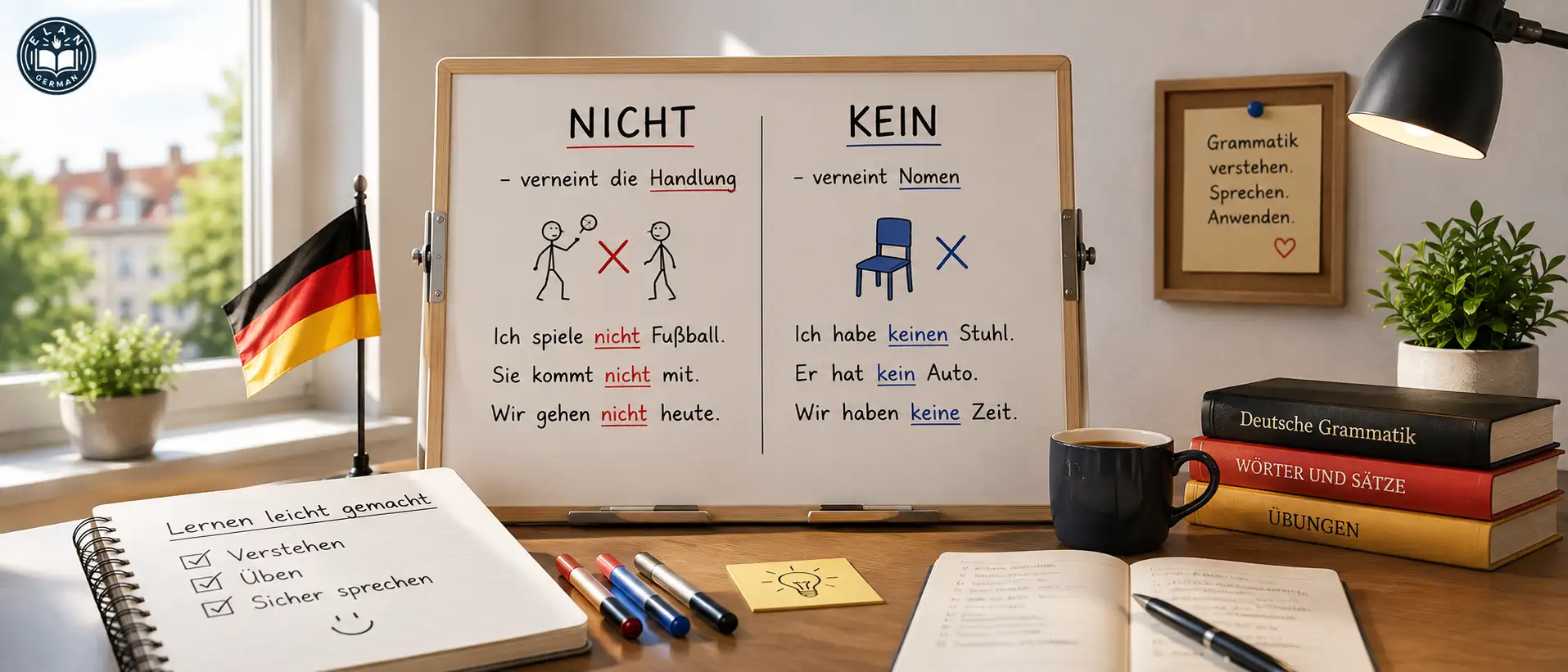
Nicht vs Kein German Negation Made Simple for Beginners
Nicht vs kein german negation comes down to one core distinction: use "kein" to negate a noun that would otherwise take "ein" or no article at all, like "Ich habe kein Auto" (I do not have a car). Use "nicht" for almost everything else: verbs, adjectives, adverbs, and nouns that already have a definite article. "Ich mag das Auto nicht" (I do not like the car) uses nicht because "das Auto" is a specific, already defined noun. The short version: if you are negating "a/an" or an uncounted noun, reach for kein. For everything else, reach for nicht. Below is the full working rule, covering how to say not in German and how to say no in German, a set of side by side examples, a table of tricky sentences that usually catch beginners off guard, and the small handful of exceptions that trip up even intermediate learners. Once this pattern clicks, most students stop having to think about it after a week or two of deliberate practice with real sentences rather than isolated word lists.
Nicht vs Kein German Negation: The Working Rule
Negating nouns in German starts with a simple mental model: think of "kein" as a negative version of the indefinite article "ein." If the positive sentence would use "ein," "eine," or no article at all, negate it with "kein" instead. This is negation with indefinite article German logic at its core. Everything else, verbs, adjectives, definite nouns, and adverbs, gets negated with "nicht." The reason this split exists traces back to how German treats indefinite reference. English speakers often want one all purpose word for not, but German divides the job between two words depending on what is actually being negated, a noun with no definite marker, or effectively everything else in the sentence.
+ Ich habe ein Buch. → − Ich habe kein Buch.
+ Ich lese das Buch. → − Ich lese das Buch nicht.
+ Sie ist müde. → − Sie ist nicht müde.
+ Ich habe Bücher. → − Ich habe keine Bücher.
Both negators combine naturally with "mehr" to express no longer or no more. "Nicht mehr" means no longer and negates a verb or ongoing state, as in "Ich rauche nicht mehr" (I do not smoke anymore). "Kein... mehr" does the equivalent job for nouns, as in "Ich habe kein Geld mehr" (I have no more money). "Mehr" slots into the sentence the same way in both patterns, right after nicht or built into the kein phrase, which makes this one of the easier extensions to pick up once the core rule is settled.
These german negation rules hold because kein behaves grammatically just like ein, taking the same case and gender endings, and this nicht vs kein german negation pattern rarely has true exceptions once the underlying logic is clear. In the nominative, kein stays kein for masculine and neuter nouns and becomes keine for feminine and plural nouns. In the accusative, masculine shifts to keinen, exactly what happens to einen. The dative and genitive follow the same logic as keinem, keiner, and keines. Once you are comfortable with how ein and der change across the four German cases, kein follows the exact same pattern, so there is no separate declension to memorize. If case endings still feel shaky, reviewing how der, die, and das shift by case tends to make the kein pattern click faster, since the two systems mirror each other closely, and these german negative sentences become far easier to build once that connection is visible.
When to Use Kein in German: Quick Decision Check
Is a noun being negated? If no, straight to nicht.
If yes, does the noun use "ein/eine" or no article in the positive sentence? Use kein.
Does the noun already have "der/die/das" or a possessive like "mein"? That's when to use nicht in German instead, placed after the noun or at the end of the clause.
Are you contrasting two options, meaning not X but Y? German usually signals this with "sondern" rather than "aber," and nicht still carries the negation itself: "Ich trinke nicht Kaffee, sondern Tee."
Working out when to use kein in German settles the noun question quickly, but exactly where nicht lands in the sentence takes a little more practice. As a general starting point, nicht goes at the end of a simple sentence when negating the whole statement, but moves earlier, right before the specific word, when you are negating just that one element rather than the entire sentence. Compare "Ich fahre heute nicht nach Berlin" (I am not going to Berlin today, general negation) with "Ich fahre nicht heute nach Berlin, sondern morgen" (I am not going today, but tomorrow, negating just "today"). This placement rule connects directly to the broader German word order rules that govern where the finite verb and other sentence elements sit, so learners who have already worked through verb position tend to find nicht placement far more intuitive than they expected.
Two intensified forms are worth learning early since they build directly on these nicht negation examples. "Gar nicht" means not at all and simply adds emphasis in front of nicht, as in "Das gefällt mir gar nicht" (I do not like that at all). "Gar kein" works the same way with the noun negator, so "Ich habe gar keine Ahnung" means I have absolutely no idea. Neither form changes the underlying rule, they only sharpen the tone, which makes them easy wins once the base nicht vs kein german negation pattern is solid. This is also where german beginner grammar negation practice tends to speed up dramatically, since learners are no longer translating word by word from English but applying one consistent rule.
Tricky Sentences That Test Nicht vs Kein German Negation
| Sentence | Correct Choice | Why |
|---|---|---|
| Ich trinke ___ Kaffee. | keinen | Kaffee has no article in the positive, so it follows the kein plus noun German pattern |
| Ich mag deinen Kaffee ___. | nicht | "deinen Kaffee" already has a possessive, so nicht applies |
| Das ist ___ gute Idee. | keine | "eine gute Idee" negates to "keine gute Idee" |
| Ich fahre ___ nach Berlin. | nicht | No noun is being negated here, only the verb phrase |
| Er ist ___ Lehrer. | kein | Professions used without an article, like "Lehrer," still take kein |
| Ich habe ___ Zeit. | keine | Uncountable nouns like "Zeit" (time) follow the same kein pattern |
| Ich habe ___ Geschwister. | keine | "Geschwister" (siblings) has no article in the positive, so keine negation with indefinite article German logic applies to the plural too |
| Das ist ___ Problem für mich. | kein | "ein Problem" negates to "kein Problem," a very common everyday phrase |
| Ich verstehe das ___. | nicht | The verb "verstehen" is being negated, not a noun, so nicht applies at the end |
Even confident intermediate speakers slip on a few recurring patterns. One common trap involves professions and nationalities. English speakers often want to insert an article, but German drops it entirely in the positive sentence, "Er ist Lehrer," so the negative also drops it, "kein Lehrer," rather than adding an article anywhere. Another frequent slip is trying to negate a possessive noun with kein when nicht is required instead, since "mein Buch" already carries a marker that blocks kein from applying. These patterns sit among the most common beginner mistakes in German, and reviewing them alongside this nicht vs kein german negation rule tends to fix both issues at the same time, since the confusion usually comes from the same root cause, translating negation word by word from English instead of asking what kind of noun or word is actually being negated. In casual spoken German, you may also hear "nix" as an informal contraction of nicht, especially in phrases like "Das geht nix" instead of the more standard "Das geht nicht." It shows up often in relaxed conversation and song lyrics, but it stays out of place in writing, exams, or anything formal, so treat it as listening comprehension knowledge rather than something to produce yourself.
Keep Building Your Grammar
Once nicht vs kein german negation feels automatic, these related guides build on the same case and word order logic you just practiced.
Further Grammar Practice
These established, well regarded resources offer additional negation drills, official grammar references, and structured practice for learners who want more repetition beyond this guide. Both organizations are frequently cited by German teachers and universities, and their exercises pair well with the tricky sentence patterns covered above.
FAQ: Nicht vs Kein German Negation Made Simple for Beginners
What is the difference between nicht and kein?
Nicht vs kein German negation comes down to this: kein negates a noun that would otherwise use ein, eine, or no article, while nicht negates verbs, adjectives, adverbs, and nouns that already have a definite article or possessive.
How do I negate a noun with no article, like Kaffee?
Use kein, since “Kaffee” without an article behaves the same way as an indefinite noun for negation purposes.
Does kein change form like an adjective?
Yes, it takes endings just like ein, so it becomes kein, keine, keinen, or keinem depending on gender and case.
Where does nicht go in a sentence?
These nicht negation examples show it usually comes after the verb and any direct object, though it can shift earlier to negate a specific word or phrase.
Can nicht negate a noun at all?
Yes, when the noun already has a definite article or possessive, like “das Auto” or “mein Buch,” you use nicht rather than kein.
Is there a quick trick to decide between the two?
Check whether the positive sentence uses “ein” or no article. If so, use kein. Otherwise, use nicht. These kein vs nicht examples make the pattern concrete quickly.
Do beginners often mix up nicht and kein?
Yes, this is one of the most common German negation mistakes beginners make, mostly because English doesn’t have an equivalent distinction.
Discover more from Elan German
Subscribe to get the latest posts sent to your email.




















One comment
[…] and so does "kein," the negative counterpart used to say there is not a rather than there is a. Our nicht versus kein guide shows this exact pattern applied specifically to […]
Comments are closed.