

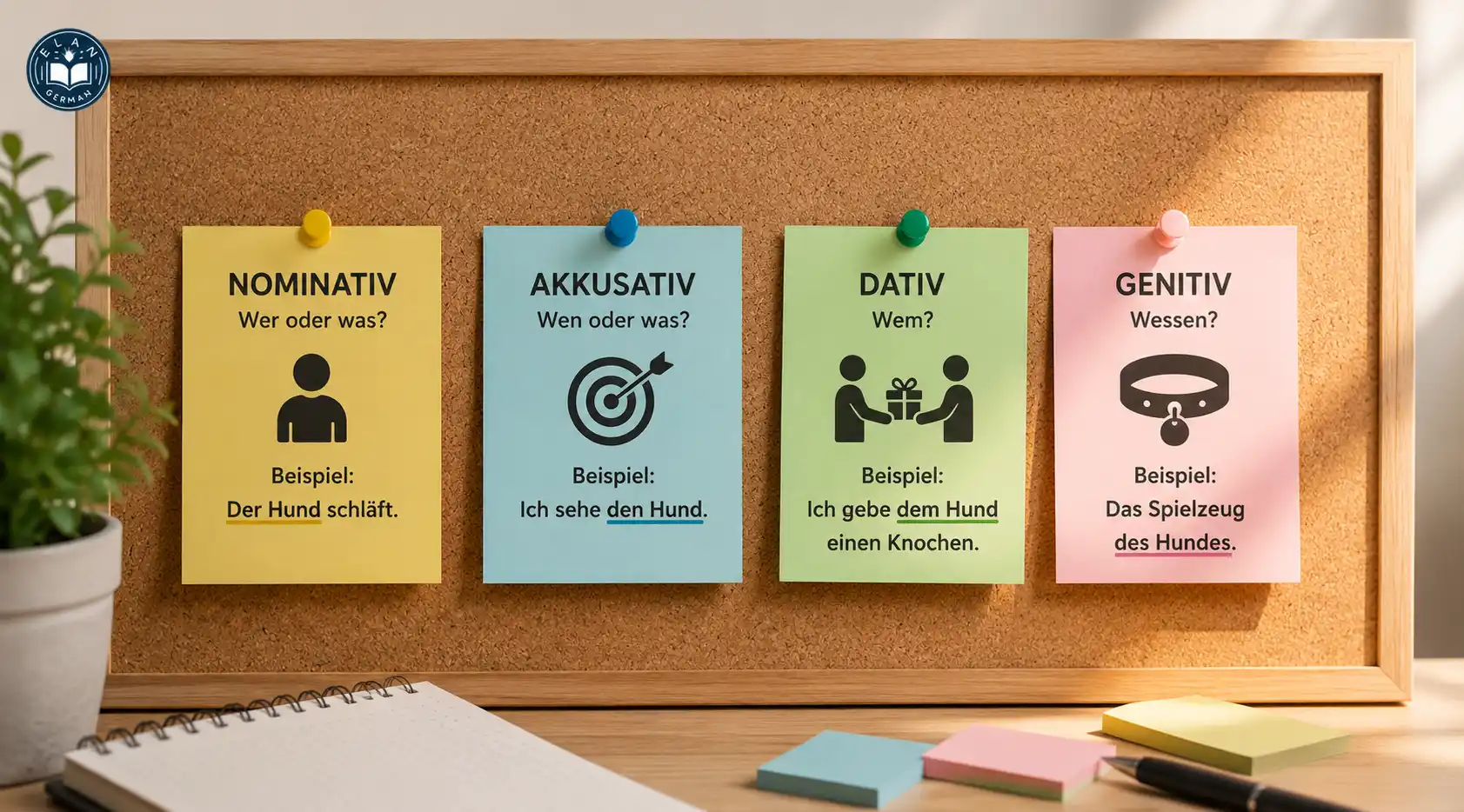
Four German Cases Explained: Nominativ to Genitiv
Four german cases explained simply: Nominativ, Akkusativ, Dativ, and Genitiv are the four grammatical cases German uses, with Nominativ marking the subject doing the action, Akkusativ the direct object receiving it, Dativ the indirect object, and Genitiv used for showing possession. The case changes the article and sometimes the noun ending, not the noun's meaning. For example "der Mann" (the man, subject) becomes "den Mann" in Akkusativ, "dem Mann" in Dativ, and "des Mannes" in Genitiv. Once you can spot which role a noun plays in a sentence, picking the right case becomes a matter of pattern recognition rather than memorization. This page walks through four german cases explained with real example sentences for both a masculine and a feminine noun, a full article table covering every gender, a second table showing how personal pronouns shift across the same four cases, and the shortcuts that actually help beginners stop guessing.
Four German Cases Explained: One Sentence, Rewritten Four Times
This german cases table is built for exactly this purpose. Take the sentence built around "the man." Watch what happens to the article as its role in the sentence changes. Reading these four rows side by side is the fastest way to internalize the whole system, since the noun itself barely changes, only its function in each sentence does.
| Case | Role | Example |
|---|---|---|
| Nominativ | Subject, who or what does the action | Der Mann liest ein Buch. (The man reads a book.) |
| Akkusativ | Direct object, who or what receives the action | Die Frau sieht den Mann. (The woman sees the man.) |
| Dativ | Indirect object, to or for whom | Sie gibt dem Mann das Buch. (She gives the man the book.) |
| Genitiv | Possession, whose | Das ist das Buch des Mannes. (That's the man's book.) |
A feminine noun makes the same point from a different angle, since feminine articles barely move at all. Take "the woman" through the identical four roles: "Die Frau kommt heute" (The woman is coming today, Nominativ), "Ich sehe die Frau" (I see the woman, Akkusativ), "Ich gebe der Frau das Buch" (I give the woman the book, Dativ), and "Das ist das Auto der Frau" (That is the woman's car, Genitiv). Notice that "die" only changes in Dativ and Genitiv, where it becomes "der," a small overlap with the masculine Nominativ form that occasionally trips up learners scanning too quickly.
Notice that only the masculine article and, in Genitiv, the noun itself change shape. That's not a coincidence, it's the reason masculine nouns get the most attention in every German grammar course. This is really the answer to why does German have cases at all: cases exist to signal grammatical roles like these without relying only on word order, which is also why German sentences can rearrange their word order far more freely than English without losing clarity about who did what to whom. Feminine and neuter nouns follow a gentler pattern, which the article table in the next section makes clear, with more genitiv case german examples covered there too.
The German Case System Explained: How the Articles Actually Change
This chart is where german cases explained nominativ akkusativ dativ genitiv gets concrete: Der Die Das only fully changes shape in Akkusativ, Dativ, and Genitiv for masculine nouns. Feminine and neuter articles shift less dramatically. This chart covers the definite article "der/die/das" across all four cases and three genders, plus the plural form that applies regardless of gender.
| Case | Masculine | Feminine | Neuter | Plural |
|---|---|---|---|---|
| Nominativ | der | die | das | die |
| Akkusativ | den | die | das | die |
| Dativ | dem | der | dem | den |
| Genitiv | des | der | des | der |
Notice masculine is the only gender that changes in Akkusativ, and Dativ plural nouns also pick up an extra "n" at the end, for example "den Männern." This is exactly why "der/die/das" deserves its own separate look, covered in our der die das guide. This same case pattern extends beyond definite articles too. Indefinite articles, "ein," "eine," and "ein," follow an almost identical shift across the four cases, and so does "kein," the negative counterpart used to say there is not a rather than there is a. Our nicht versus kein guide shows this exact pattern applied specifically to negation.
Personal pronouns shift across these same four cases too, and since pronouns show up in nearly every sentence, this table often pays off faster than the article chart above.
| Nominativ | Akkusativ | Dativ | Genitiv |
|---|---|---|---|
| ich | mich | mir | meiner |
| du | dich | dir | deiner |
| er/sie/es | ihn/sie/es | ihm/ihr/ihm | seiner/ihrer/seiner |
| wir | uns | uns | unser |
| ihr | euch | euch | euer |
| sie/Sie | sie/Sie | ihnen/Ihnen | ihrer/Ihrer |
Genitiv pronouns like "meiner" and "deiner" are rare in modern German, mostly surviving in set phrases and formal writing, but Akkusativ and Dativ pronouns, "mich," "dich," "mir," "dir," and their counterparts, appear constantly in everyday speech. "Er liebt sie" (He loves her, Akkusativ) and "Sie hilft ihm" (She helps him, Dativ) are the kind of sentences you will produce dozens of times a day once conversational German becomes routine.
Adjective endings shift alongside these german case endings too, following the same underlying logic. Once the article pattern above feels automatic, adjective endings become far easier to predict, since they are essentially filling in whatever grammatical information the article has not already signaled. Our adjective endings guide picks up exactly where this table leaves off.
Three Shortcuts That Actually Help
Ask "who or what"
That question always finds your nominativ case german subject. Whatever answers it is the doer of the action, no exceptions.
Ask "to or for whom" (When to Use Dativ in German)
That question points straight to your Dativ object, the person or thing on the receiving end of an indirect benefit.
Learn verbs by pattern
Verbs like "geben" and "helfen" pair with specific cases, learning the verb and its case together saves guesswork later, since some verbs, like "helfen," take Dativ even though English intuition suggests otherwise.
Prepositions add another layer worth knowing early. Certain prepositions always trigger Akkusativ, others always trigger Dativ, and a group of nine, called Wechselpräpositionen, switch between the two depending on whether the sentence describes movement or a fixed location. Our full preposition list groups every common preposition by the case it demands, which pairs well with these four german cases explained here once you are ready to move past single sentence examples.
A handful of common verbs deserve special mention because they take Dativ against English intuition. Beyond "helfen" (to help), watch for "danken" (to thank), "gefallen" (to please or be liked), "gehören" (to belong to), and "gratulieren" (to congratulate). "Das Auto gehört meinem Vater" (The car belongs to my father) uses Dativ because "gehören" simply requires it, not because the sentence is expressing an indirect object in any obvious way. Treating these as vocabulary to memorize alongside their case, rather than trying to reason out the case from the English translation, avoids one of the most persistent mistakes at the intermediate level.
None of this needs to be memorized in one sitting. Most learners build case awareness gradually, first internalizing Nominativ and Akkusativ through everyday statements, then adding Dativ once verbs like "geben" and "helfen" become routine, and finally picking up Genitiv mostly through reading rather than active production, since even native speakers lean on "von plus Dativ" in casual conversation. Revisiting this page after a few weeks of practice, once real sentences have replaced the example ones, is often when the pattern truly clicks.
German Grammar Cases for Beginners: Keep Building
Now that these four german cases explained here feel more concrete, these related guides cover the pieces that build directly on top of case.
Reliable Places to Practice Further
These established, well regarded language resources offer free case drills, reference tables, and interactive exercises if you want more practice beyond this page. Working through a mix of written drills and audio listening reinforces the pattern faster than reading alone.
FAQ: Four German Cases Explained: Nominativ to Genitiv
How many cases are in German, and what are they?
German cases explained simply: Nominativ, Akkusativ, Dativ, and Genitiv, each showing a different role a noun plays in a sentence.
What is Nominativ used for?
It marks the subject of the sentence, the person or thing doing the action.
Akkusativ vs Dativ: what's the real difference?
Akkusativ marks the direct object receiving the action; Dativ marks the indirect object, usually who something is given to or done for. Knowing when to use Akkusativ in German versus Dativ comes down to spotting the direct object.
Is Genitiv case disappearing from spoken German?
It’s used less in casual speech, often replaced by “von plus Dativ,” but it’s still expected in formal and written German.
How do I know which case a verb takes?
Many verbs pair with a fixed case by convention. Learning the verb and its case together, like “helfen” with Dativ, removes the guesswork.
Does case affect adjective endings too?
Yes, adjective endings shift along with the article depending on case, gender, and whether the noun uses a definite or indefinite article.
What's the easiest way to practice German cases?
Take one simple sentence and rewrite it across all four cases, exactly like the example table above, until this four cases german grammar pattern feels automatic.
Discover more from Elan German
Subscribe to get the latest posts sent to your email.