
Sein Haben Conjugation German A1: Complete Guide
Mastering sein haben conjugation german a1 starts with just two words: "Sein" (to be) and "haben" (to have) are the two verbs every German sentence structure eventually depends on, from basic descriptions of yourself to the entire Perfekt past tense, which uses conjugated forms of these two verbs as its backbone. Both are irregular, so their present tense forms do not follow the standard conjugation pattern and need to be memorized directly. "Ich bin" (I am), "du bist" (you are), and "er ist" (he is) look nothing like a regular verb stem, and the same is true for "ich habe," "du hast," and "er hat." Getting both fully automatic before moving on to other grammar pays off constantly, since so much of German sentence building leans on them. This page covers the complete present tense table for both verbs, the everyday sentence patterns and idioms each one builds, how negation and questions work with each, and why the two verbs matter just as much once you move beyond A1 into past tense grammar. Most A1 textbooks and courses, including the Goethe Institut curriculum, introduce sein and haben in the very first lesson for exactly this reason, everything from introducing yourself to describing your family depends on having these two verbs ready without hesitation. Treat the next few sections as a single sitting worth of practice rather than reference material to skim, since drilling both tables aloud now saves considerable frustration once longer sentences and past tense forms enter the picture.
Sein Haben Conjugation German A1: Both Verbs, Side by Side
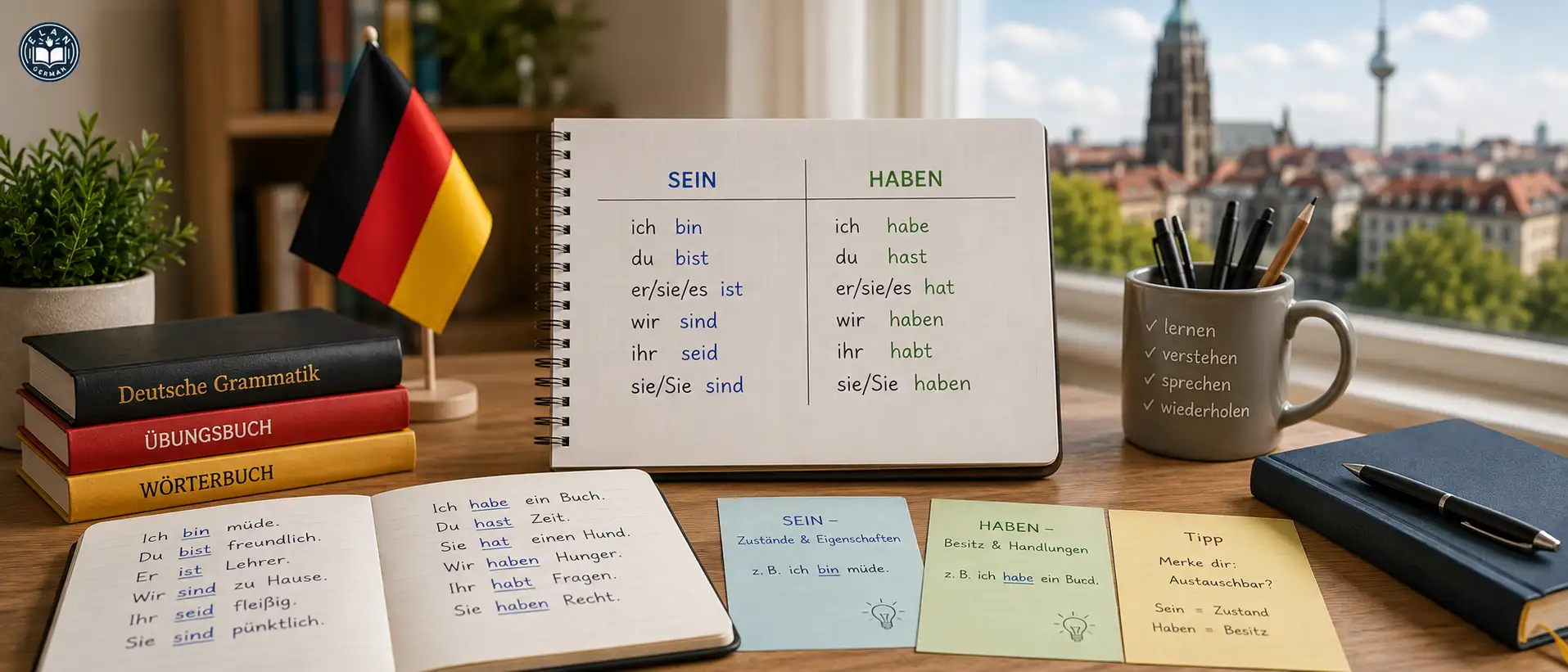
| Pronoun | Sein (to be) | Haben (to have) |
|---|---|---|
| ich | bin | habe |
| du | bist | hast |
| er/sie/es | ist | hat |
| wir | sind | haben |
| ihr | seid | habt |
| sie/Sie | sind | haben |
Sein conjugation german and haben conjugation german both break the regular pattern taught for most German verbs, which is exactly why they need direct memorization rather than rule based deduction. Say the full table aloud daily for a week, and this german verb basics a1 pattern becomes automatic faster than most learners expect.
Note that "sie/Sie" covers three different meanings depending on capitalization and context: lowercase "sie" means "she" or "they," while capitalized "Sie" is the formal way to address one person or a group, always paired with the same "sind" or "haben" form regardless. Our du versus Sie guide covers when to reach for the formal form in more depth. Negation follows the ordinary nicht pattern for both verbs, since neither takes an object that would call for kein: "Ich bin nicht müde" (I am not tired) and "Ich habe nicht viel Zeit" (I do not have much time). Questions invert the usual subject verb order, sending the conjugated form to the very front: "Bist du müde?" (Are you tired?) and "Hast du Zeit?" (Do you have time?), a pattern that holds for every verb in German, not just these two.
Sein vs Haben German: The Sentence Patterns Each Verb Unlocks
Sein Builds Descriptions
"Ich bin müde" (I am tired), "Er ist Student" (He is a student), "Wir sind aus Indien" (We are from India). Any sentence describing a state, identity, or origin runs through sein. Notice "Er ist Student" drops the article entirely, unlike English "a student," a pattern that also applies to nationalities: "Ich bin Inder" (I am Indian), not "Ich bin ein Inder," unless an adjective is added, "Ich bin ein stolzer Inder" (I am a proud Indian).
Haben Builds Possession
"Ich habe Zeit" (I have time), "Sie hat einen Bruder" (She has a brother), "Wir haben Hunger" (We are hungry, literally "we have hunger"). Note German uses haben for states English expresses with "to be," like hunger and thirst. These sein haben examples cover the most common everyday patterns, and both verbs combine constantly with numbers and family vocabulary in typical A1 introductions, "Ich habe zwei Geschwister" (I have two siblings) and "Ich bin zwanzig Jahre alt" (I am twenty years old). Age is one of the rare cases where German actually matches English logic, both languages use "to be" rather than "to have," which makes it a welcome break from the hunger and thirst pattern covered below.
Getting sein haben conjugation german a1 right also means learning these quirky expressions, part of the broader sein haben sentence patterns worth memorizing. That last point trips up many beginners. English says "I am hungry," but German says "Ich habe Hunger," using haben rather than sein. The same pattern applies to "Angst haben" (to be afraid, literally "to have fear") and several other common expressions.
| Haben Expression | Literal Meaning | Actual Meaning |
|---|---|---|
| Hunger haben | to have hunger | to be hungry |
| Durst haben | to have thirst | to be thirsty |
| Angst haben | to have fear | to be afraid |
| Recht haben | to have right | to be right |
| Lust haben | to have desire | to feel like doing something |
| Zeit haben | to have time | to have time (matches English) |
One related construction worth flagging even though it uses neither verb directly: "es gibt" (there is, there are), built from "geben" (to give), not from sein or haben, as many English speakers initially assume. "Es gibt viele Cafés hier" (There are many cafes here) always pairs with Akkusativ, regardless of how many things there are, which makes it one of the few constructions where subject verb agreement does not follow the usual number matching rule.
Mixing up sein and haben in these fixed expressions is one of the most common a1 level mistakes, precisely because English structures the same idea around "to be" instead. Reviewing these patterns alongside our common beginner mistakes guide catches this alongside other early errors that are easy to fix once you know to look for them.
It also helps to separate sein from "werden" (to become) early on, since both touch on states but describe different things: sein names a condition that already exists, while werden names a change still happening. "Ich bin müde" (I am tired) describes the current state, while "Es wird kalt" (It is getting cold) describes weather in the process of changing, not "Es ist kalt werden," a direct translation error that shows up often in early writing. Werden deserves its own separate study later, but recognizing this contrast now prevents one recurring source of confusion. A similar contrast comes up with "haben" versus "bekommen" (to receive or get), since English "get" can mean both receiving something and becoming something, while German keeps the two ideas apart, "Ich bekomme ein Geschenk" (I am getting a gift) uses bekommen, never haben, even though a direct translation instinct sometimes reaches for haben instead.
Why This Matters Beyond Present Tense
This is exactly why sein haben conjugation german a1 practice pays off long term: both verbs come back constantly once you reach the past tense. The Perfekt past tense is built entirely from a conjugated form of sein or haben acting as german auxiliary verbs plus a past participle, so every past tense sentence you will ever build in spoken German leans directly on getting these two present tense conjugations fully automatic first.
As a quick preview, most movement verbs, like "gehen" and "fahren," pair with sein in Perfekt, while most other verbs pair with haben, so "Ich bin gegangen" (I went) but "Ich habe gegessen" (I ate). Sein and haben themselves also have their own Perfekt forms, "Ich bin gewesen" (I have been) and "Ich habe gehabt" (I have had), though in casual speech the present tense forms covered above usually get used instead, exactly the exception covered in the Perfekt versus Präteritum guide linked above.
Keep Building Your Foundational German Grammar
Sein haben conjugation german a1 is the first building block, these guides cover what comes right after it.
Further Practice Resources
These established, well regarded resources offer additional drills and audio for practicing sein and haben, as part of core german a1 grammar basics. Pairing spoken audio with the written table above builds both recognition and recall, which matters since A1 speaking tests expect these forms to come out instantly.
FAQ: Sein Haben Conjugation German A1: Complete Guide
Why are sein and haben so important in German?
Sein haben conjugation German A1 basics matter because they’re both irregular and extremely frequent, and they form the backbone of the Perfekt past tense, making them essential before other grammar makes sense.
How do you conjugate sein in the present tense?
ich bin, du bist, er/sie/es ist, wir sind, ihr seid, sie/Sie sind.
How do you conjugate haben in the present tense?
ich habe, du hast, er/sie/es hat, wir haben, ihr habt, sie/Sie haben.
Why does German use haben for hunger instead of sein?
German expresses states like hunger and fear using haben, literally “to have,” where English uses “to be,” so “Ich habe Hunger” means “I am hungry.” This to be to have German swap trips up nearly every beginner at first.
Are sein and haben used to form other tenses?
Yes, the Perfekt past tense is built using a conjugated form of sein or haben plus a past participle.
Which verb should I learn first, sein or haben?
Both are equally essential and typically taught together at the very start of A1-level German, since they’re the first A1 German verbs every learner meets.
Do sein and haben follow regular conjugation patterns?
No, both are irregular verbs and need to be memorized directly rather than deduced from a standard conjugation rule.
Discover more from Elan German
Subscribe to get the latest posts sent to your email.