
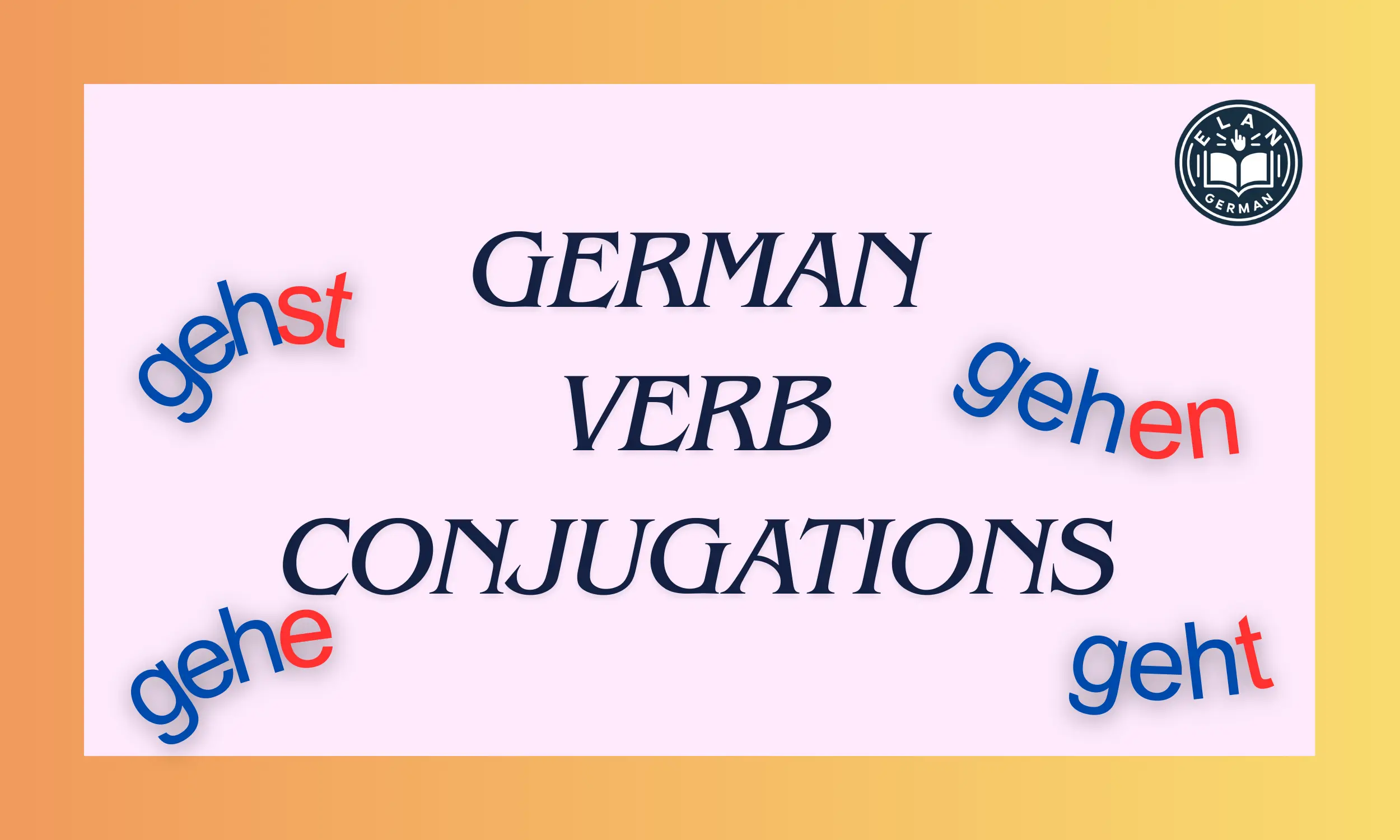
German Verb Conjugation Explained
German verb conjugation follows predictable patterns that make more sense than English once you understand the system. Most verbs use the same endings across tenses, irregular verbs follow consistent groups, and the logic behind each form connects directly to who's doing the action and when.
What You'll Learn
- Why german verb conjugation rules are more logical than you think
- The patterns that work for 90% of verbs
- How to practice german verb conjugation effectively
- Real german verb conjugation examples you'll use daily
What Is Verb Conjugation in German?
Verb conjugation means changing the verb form based on who does the action and when it happens. In German, you take the infinitive (the base form ending in "en") and modify it according to specific patterns.
Here's the thing: German conjugation follows stricter rules than English. While English often uses helper words (I will go, I am going), German builds everything into the verb itself. This sounds complex but actually makes the system more predictable.
Basic Example: "spielen" (to play)
You remove "en" and add specific endings. The stem "spiel" stays the same. The ending tells you everything about who and when.
| Person | Ending | Example | English |
|---|---|---|---|
| ich (I) | e | ich spiele | I play |
| du (you) | st | du spielst | you play |
| er/sie/es | t | er spielt | he/she/it plays |
| wir (we) | en | wir spielen | we play |
| ihr (you all) | t | ihr spielt | you all play |
| sie/Sie | en | sie spielen | they/you (formal) play |
Notice how the endings repeat? "t" appears twice, "en" appears three times. Once you learn these six endings, you can conjugate thousands of regular verbs. That's what makes german verb conjugation rules so practical.
Ready to Test Your German Skills?
Take our free German A1 test online and see where you stand. Get instant results and know exactly what to practice next.
Start Free A1 TestAlso check: How to Pass Goethe A1 Exam
German Verb Conjugation Patterns That Repeat
Most German verbs follow the same conjugation pattern. Learn one chart and you've mastered the majority of german verb conjugation rules. Let's look at how this works across different verb types.
Regular Verbs: Your Foundation
These verbs keep their stem unchanged. You just add the endings. About 90% of German verbs work this way.
| Person | lernen (learn) | machen (make) | wohnen (live) |
|---|---|---|---|
| ich | lerne | mache | wohne |
| du | lernst | machst | wohnst |
| er/sie/es | lernt | macht | wohnt |
| wir | lernen | machen | wohnen |
| ihr | lernt | macht | wohnt |
| sie/Sie | lernen | machen | wohnen |
Pro tip: If you know how to use German pronouns, conjugation becomes automatic. The pronoun tells you which ending to use every time.
Stem-Changing Verbs: The Predictable Exception
Some verbs change their stem vowel in the du and er/sie/es forms. But they still use the same endings. The pattern remains consistent.
| Person | essen (eat) | fahren (drive) | sehen (see) |
|---|---|---|---|
| ich | esse | fahre | sehe |
| du | isst | fährst | siehst |
| er/sie/es | isst | fährt | sieht |
| wir | essen | fahren | sehen |
| ihr | esst | fahrt | seht |
| sie/Sie | essen | fahren | sehen |
Notice the pattern? The stem changes only in two forms. Everything else follows the regular rules. This is what makes german conjugation learnable.
Irregular German Verb Conjugation: The Most Common Ones
Some verbs don't follow the standard pattern. But here's what makes sense: the most irregular verbs are also the most used. You'll practice them so often that they become automatic.
German Verb Conjugation: haben (to have)
You use "haben" constantly in German. It's your helping verb for past tense and appears in countless everyday phrases.
| Person | Conjugation | Example Sentence |
|---|---|---|
| ich | habe | Ich habe Zeit. (I have time.) |
| du | hast | Du hast Recht. (You are right.) |
| er/sie/es | hat | Sie hat Hunger. (She is hungry.) |
| wir | haben | Wir haben Glück. (We are lucky.) |
| ihr | habt | Ihr habt Fragen. (You have questions.) |
| sie/Sie | haben | Sie haben Erfahrung. (They have experience.) |
German Verb Conjugation: gehen (to go)
Another high-frequency verb. "Gehen" follows a stem-changing pattern but becomes second nature quickly.
| Person | Conjugation | Example Sentence |
|---|---|---|
| ich | gehe | Ich gehe nach Hause. (I go home.) |
| du | gehst | Du gehst zur Arbeit. (You go to work.) |
| er/sie/es | geht | Er geht spazieren. (He goes for a walk.) |
| wir | gehen | Wir gehen einkaufen. (We go shopping.) |
| ihr | geht | Ihr geht ins Kino. (You go to the cinema.) |
| sie/Sie | gehen | Sie gehen essen. (They go eating.) |
Want More Practice?
Check out common German mistakes beginners make to avoid errors when using these verbs. Understanding German adjectives will also help you build more complex sentences.
How to Practice German Verb Conjugation Effectively
Knowing the rules is one thing. Using them automatically is another. Here's what works for moving from theory to fluent practice.
Start With High-Frequency Verbs
Focus on the 50 most common verbs first. You'll use these in 80% of conversations. Master sein (to be), haben (to have), machen (to make), gehen (to go), and kommen (to come) before moving to less common verbs.
Practice in Context, Not Lists
Don't just memorize conjugation tables. Write sentences you'd actually say. "Ich gehe ins Kino" sticks better than "gehe, gehst, geht" repeated endlessly. Check out how to write German emails for real-world sentence practice.
Group Similar Patterns Together
Learn stem-changing verbs in groups. All verbs that change "e" to "i" (like geben, nehmen, sprechen) behave the same way. This makes german verb conjugation practice more efficient.
Use Flashcards for Irregular Verbs Only
Regular verbs follow the pattern automatically once you know it. Save flashcard time for the 50 or so truly irregular verbs that need memorization.
Speak Aloud Every Day
Your mouth needs muscle memory too. Say your conjugations out loud. Record yourself. The physical act of speaking reinforces the patterns faster than silent reading.
Test Yourself Weekly
Take a quick german verb conjugation worksheet or quiz every week. Track which verbs you mess up and focus there. Our German A1 test includes verb sections perfect for this.
Your 30-Day Conjugation Practice Plan
Master present tense regular verbs. Practice 10 verbs daily with all six pronouns. Use each in three different sentences.
Add stem-changing verbs. Learn the common patterns (e to i, a to ä, e to ie). Practice with real conversations about daily activities.
Focus on sein, haben, werden, and modal verbs. These appear everywhere. Create a personal story using all of them.
Mix everything together. Write emails, journal entries, or practice basic German greetings and introductions using correct conjugations.
Common Conjugation Mistakes to Avoid
| Wrong | Right | Why It Matters |
|---|---|---|
| du arbeit | du arbeitest | Verbs ending in -t need an extra 'e' before -st |
| ich denkt | ich denke | First person always gets -e, never -t |
| er gehen | er geht | Third person singular needs -t, not infinitive |
| wir isst | wir essen | Plural forms return to regular stem |
Want to avoid more errors? Read about German mistakes beginners make to catch these early.
German Verb Conjugation Exercises to Try Now
Theory only takes you so far. These german verb conjugation exercises help you apply what you've learned. Start with the basics and work up to more complex sentences.
Exercise 1: Fill in the Blanks (Regular Verbs)
BeginnerComplete these sentences with the correct form of the verb in parentheses.
1. Ich _____ jeden Tag Deutsch. (lernen)
✓ lerne (I learn German every day.)
2. Du _____ sehr gut Gitarre. (spielen)
✓ spielst (You play guitar very well.)
3. Er _____ in Berlin. (wohnen)
✓ wohnt (He lives in Berlin.)
4. Wir _____ am Wochenende. (arbeiten)
✓ arbeiten (We work on weekends.)
Exercise 2: Stem-Changing Verbs
IntermediateThese verbs change their stem in du and er/sie/es forms. Choose the correct conjugation.
1. Sie _____ jeden Morgen Brot. (essen - to eat)
✓ isst (She eats bread every morning.) - stem changes from e to i
2. Du _____ sehr schnell Auto. (fahren - to drive)
✓ fährst (You drive very fast.) - stem changes from a to ä
3. Er _____ ein Buch. (lesen - to read)
✓ liest (He reads a book.) - stem changes from e to ie
Exercise 3: Mixed Conjugation Practice
AdvancedTranslate these sentences into German using proper verb conjugation. This tests your understanding of German family members vocabulary too.
1. My mother has three children.
✓ Meine Mutter hat drei Kinder.
2. We go to the supermarket.
✓ Wir gehen zum Supermarkt.
3. You (formal) speak German very well.
✓ Sie sprechen sehr gut Deutsch.
Quick Reference: German Verb Conjugation Table
Save this german verb conjugation chart for quick reference when doing exercises.
| Pronoun | Regular Ending | Example (machen) | Notes |
|---|---|---|---|
| ich | -e | ich mache | Always -e for first person |
| du | -st | du machst | Add -e before -st for -t/-d stems |
| er/sie/es | -t | er macht | Stem changes happen here |
| wir | -en | wir machen | Same as infinitive |
| ihr | -t | ihr macht | Informal plural you |
| sie/Sie | -en | sie machen | Same as infinitive |
FAQ: German Verb Conjugation Explained
What is verb conjugation in German?
Verb conjugation in German means changing the verb form based on who does the action (ich, du, er, etc.) and when it happens. You take the infinitive form (like spielen), remove the -en ending, and add specific endings that match the pronoun. The system follows consistent patterns, making it more predictable than it first appears.
Is German verb conjugation harder than English?
Not really. German actually follows stricter rules than English, which makes it more predictable once you learn the patterns. English uses helper words (I will go, I am going), while German builds everything into the verb itself. The six endings you learn for the present tense work across thousands of verbs. The challenge is memorising irregular verbs, but those are the same verbs you use constantly, so practice happens naturally.
How long does it take to learn German verb conjugation?
You can master basic present tense conjugation in about a month with daily practice. Spend week one on regular verbs, week two on stem-changing patterns, week three on the most common irregular verbs (sein, haben, werden), and week four mixing everything in real sentences. After that, it’s about building vocabulary and practising different tenses.
What are the most important German verbs to conjugate first?
Start with sein (to be), haben (to have), machen (to make/do), gehen (to go), and kommen (to come). These five verbs appear in almost every conversation. Add sprechen (to speak), essen (to eat), trinken (to drink), wohnen (to live), and arbeiten (to work) next. Master these ten, and you can handle most basic conversations while learning the conjugation system.
Do all German verbs follow the same conjugation pattern?
About 90% of German verbs follow the regular pattern with the same six endings (e, st, t, en, t, en). Stem-changing verbs modify the vowel in du and er/sie/es forms but still use those same endings. Only a small group of truly irregular verbs (like sein and haben) break the pattern completely. The good news? Those irregular verbs are so common that you’ll memorise them quickly through daily use.
How can I practice German verb conjugation effectively?
Write sentences you’d actually say instead of memorising lists. Create a personal story about your daily routine using different verbs. Record yourself speaking conjugations aloud to reinforce muscle memory. Use flashcards only for irregular verbs. Take weekly quizzes to identify areas for improvement. Most importantly, practice in context by writing emails, journal entries, or having conversations where you must conjugate verbs naturally.
What's the difference between German verb conjugation haben and regular verbs?
Haben is irregular and doesn’t follow the standard pattern. Instead of hab-e, hab-st, hab-t, you get habe, hast, hat. The pattern breaks in the du and er/sie/es forms. This matters because haben is one of the most used verbs in German. You need it for past tense constructions and common phrases like “Ich habe Hunger” (I’m hungry). The irregularity makes it harder to learn at first, but you’ll use it so often that it becomes automatic within a few weeks.
Discover more from Elan German
Subscribe to get the latest posts sent to your email.