
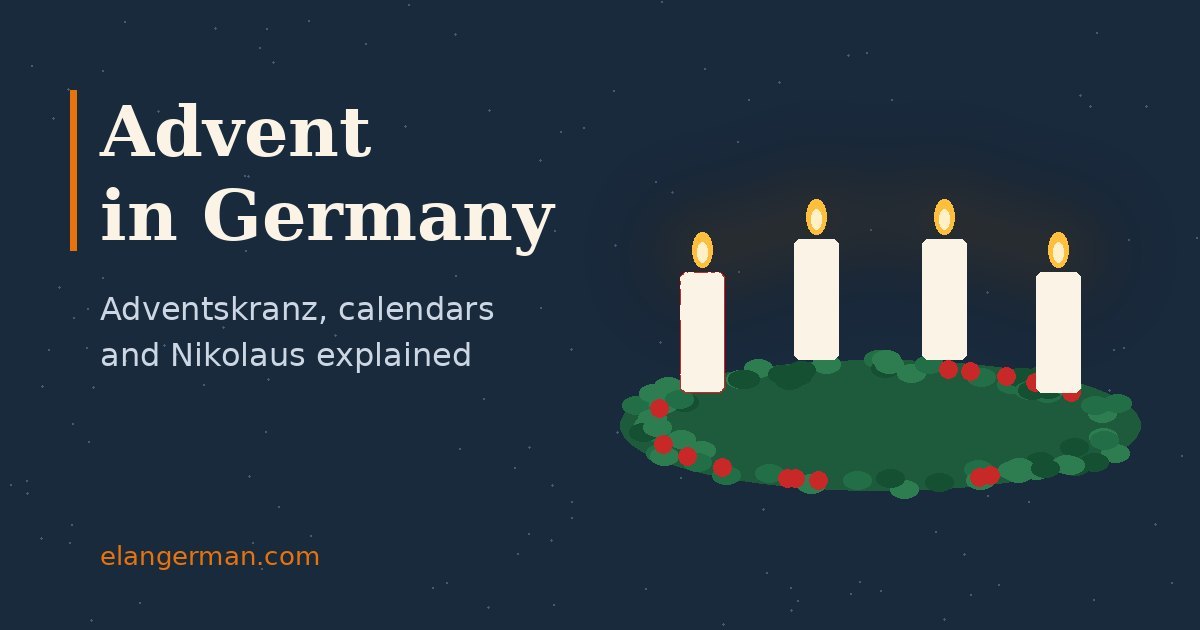
Advent in Germany: Adventskranz, Advent Calendars and Traditions
Advent traditions in Germany, from calendars to wreaths, trace back to the four Sundays before Christmas, built around two customs that both originated in Germany and later spread worldwide, the Advent calendar and the Advent wreath, or Adventskranz. The wreath holds four candles, one lit on each successive Sunday, building toward a fully lit wreath by Christmas Eve. Advent calendars, originally simple chalk marks or paper doors counting down the days, became a printed tradition in German households by the early 1900s before evolving into the chocolate filled versions sold worldwide today. Both customs turn the run up to Christmas into a structured, anticipatory season rather than a single day of celebration.
Adventszeit in Germany, the Advent period itself, still shapes daily life in noticeable ways today. Radio stations shift their playlists, bakeries fill their windows with Stollen and Lebkuchen, and family calendars fill up with Adventssonntag gatherings, school nativity plays and neighborhood market visits. For many German families, these four weeks carry as much emotional weight as Christmas Day itself, since the anticipation is treated as part of the celebration rather than a mere countdown to it.
Where the Adventskranz Actually Comes From
The Advent wreath's origin is often traced to Johann Hinrich Wichern, a Protestant theologian working at the Rauhes Haus charitable institution in Hamburg in 1839, who built a large wooden ring holding candles to help children there count down the days to Christmas. His original version held nineteen small candles for weekdays and four larger ones for the Sundays, mounted on a wagon wheel suspended from the ceiling. The design was gradually simplified over the following decades into the four candle version now standard in most German homes, made of evergreen branches and typically featuring one candle for each Sunday of Advent. Why do Germans have Advent wreaths at all? Largely because the original charitable purpose caught on so widely that it became a fixture of German homes well beyond its religious roots.
The lighting sequence itself carries meaning beyond simple counting, and the advent wreath candle lighting order follows the same pattern in almost every German household. Each Sunday adds one more lit candle, so the wreath grows visibly brighter across the month, mirroring the approach toward Christmas both symbolically and literally as the room fills with more candlelight each week.
Candle color carries its own small tradition too. Catholic households sometimes follow the liturgical calendar, using three purple candles and one pink candle for the third Sunday, known as Gaudete Sunday, which marks a shift toward joy partway through the season. Protestant and secular households more often use four matching red or white candles instead, and either version is considered entirely correct, since regional and family habit matters more here than any fixed national rule.
Advent wreath candles meaning extends past the calendar count as well. Many families treat the moment of lighting each candle as a small weekly ritual, gathering briefly before dinner or during a Sunday afternoon to sing a short verse or share a quiet moment together, a pause that modern households often value precisely because so little else in December moves that slowly.
The wreath's evergreen base is not accidental either. Fir and pine branches were chosen because they stay green through winter, a visual reminder of life continuing through the coldest, darkest weeks of the year, long before electric lighting made winter evenings less dark by default. Ribbons, pinecones and small ornaments are common additions in modern versions, though the four candle count remains the one element that almost never changes across regions or households.
Workplaces and schools across Germany often keep a scaled down version of the same custom, lighting a shared wreath in the staff room or classroom each Monday morning of Advent. It is a small gesture, but one that keeps the tradition visible well beyond private homes, reinforcing it as a shared cultural marker rather than a purely domestic habit. Anyone researching Advent traditions in Germany, from calendars to wreaths, quickly finds that this wreath ritual is the single most consistent household detail across an otherwise varied and regional holiday season.
German Advent Calendar History and Printed Origins
Before printed calendars existed, some German families simply marked chalk lines on a door or wall, one erased each day, to count down to Christmas. Other households baked or bought twenty four small treats, one unwrapped daily. The first known printed Advent calendars appeared in Germany in the early twentieth century, with Munich publisher Gerhard Lang widely credited around 1908 for producing an early commercial version with small doors that opened to reveal an image underneath. Chocolate filled versions came later and eventually became the dominant global format, though the basic concept, one small daily reveal building anticipation toward Christmas, has stayed consistent since its earliest German origins.
| Format | Era |
|---|---|
| Chalk marks or paper doors | 19th century, informal household tradition |
| Printed picture calendars | Early 20th century, first commercial versions |
| Chocolate filled calendars | Mid 20th century onward, now the global standard |
| Shop window calendars | Mid 20th century, large scale public versions in city centers |
| Digital and app based calendars | 21st century, daily notifications alongside physical versions |
The german word for advent calendar, Adventskalender, is one of the more useful compound words for a learner to recognize early, since it appears everywhere in shops and packaging from late November onward. History of advent calendars also shows an interesting split between religious and secular versions, some calendars still print a short Bible verse behind each door, continuing the format's original charitable and devotional purpose, while most modern retail versions have moved entirely toward toys, cosmetics, or sweets aimed at a general audience.
German christmas countdown tradition has also expanded well beyond the classic cardboard calendar. Coffee brands, toy companies, and even beer breweries now release themed twenty four day countdowns, and many German offices run informal desk calendars where colleagues take turns bringing a small daily treat for the whole team through the first three weeks of December.
Children in particular grow up treating the calendar as a daily ritual rather than a novelty item, often checking it before breakfast every single morning of December. Parents sometimes build their own version from scratch, filling twenty four small numbered bags or boxes with a mix of sweets, tiny toys, and handwritten notes, a homemade approach that has become popular again in recent years as families look for a more personal alternative to mass produced options.
Schools frequently join in as well, with classrooms keeping a large communal calendar on the wall and a different student opening the day's door each morning, turning what began as a private household custom into something shared publicly across an entire community throughout the four weeks before Christmas.
Fun Fact
Advent sunday traditions also mark the opening weeks of Germany's famous Christmas markets, which typically open on or just before the first Advent Sunday and run through the following weeks, making Advent season and Christmas market season almost entirely overlapping in the German calendar. Our full guide to those markets covers the food, the mulled wine, and the regional differences in far more depth than we will repeat here.
Beyond the markets, four weeks before christmas germany also brings a wave of home baking. Families gather to bake Plätzchen, small spiced or buttery cookies, often on the first weekend of Advent, and it is common for the same handful of family recipes to reappear every single year, sometimes handwritten and passed down for three or four generations.
Anyone tracking Advent traditions in Germany, from calendars to wreaths, for the first time will also notice how much the season leans on shared, low key ritual rather than one single big event, a gentler build than many other national holiday seasons attempt, and one many newcomers to Germany come to appreciate once they experience a full Advent themselves.
German words you will hear
Learn these before you go and you will understand far more of what is happening around you.
| der Advent | the four weeks before Christmas |
| der Adventskranz | Advent wreath with four candles |
| der Adventskalender | Advent calendar |
| der Nikolaustag | St Nicholas Day, 6 December |
| der Glühwein | hot spiced wine |
| die Plätzchen | Christmas biscuits |
Want to learn more German like this? Try our free German learning games.
Further Reading
These established cultural and tourism sources cover Advent traditions in Germany, from calendars to wreaths, and German Christmas traditions in more depth.
Discover more from Elan German
Subscribe to get the latest posts sent to your email.