
How to Pronounce German Umlauts | Ä Ö Ü Explained
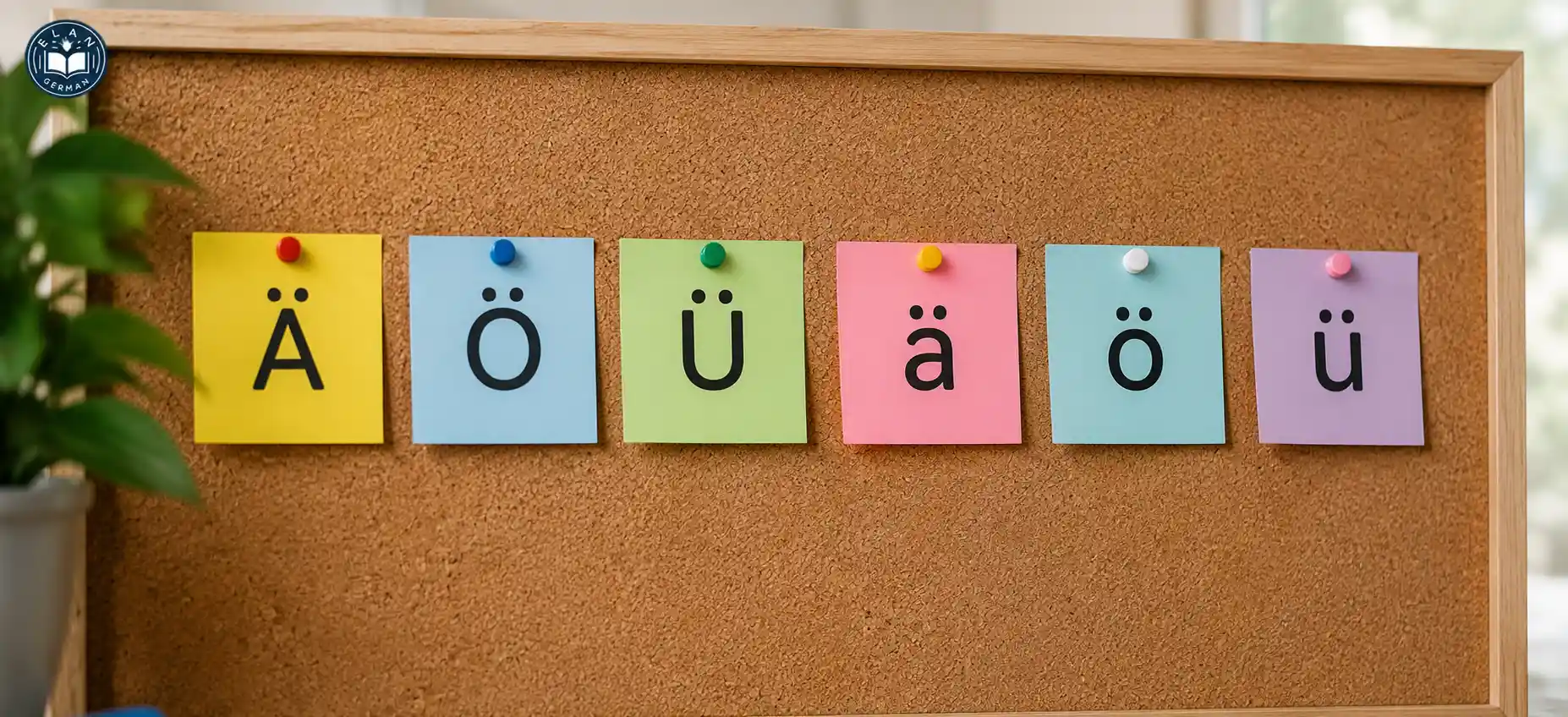
Knowing how to pronounce german umlauts starts with this: umlauts change a vowel's sound, not just its spelling. Ä sounds like the "e" in "bed." Ö is made by rounding your lips as if saying "o," while actually pronouncing "e." Ü is made by rounding your lips fully, as if whistling, while saying "ee." The trick for ö and ü is holding your lips in one position while your tongue produces a different vowel, that mismatch between lips and tongue is exactly what creates the umlaut sound English speakers usually get wrong on the first try. This page breaks down each umlaut individually, compares them directly to their base vowels, and gives a practice method for training your ear to hear the difference.
Learning how to pronounce umlauts a o u properly early on saves real trouble later, because these three sounds separate whole pairs of words that otherwise look almost identical on the page. Schon (already) and schön (beautiful), or Buch (book) and Bücher (books), are worlds apart in meaning once spoken correctly, and mixing them up in conversation causes far more confusion than any grammar mistake ever does.
How to Pronounce Umlauts A O U, One at a Time
Ä
Mouth: Relaxed, slightly open, same as the vowel in "bed" or "let."
Example: Mädchen (girl), Bäcker (baker).
Ö
Mouth: Round your lips as if saying "o," then say "e" without changing your lip shape.
Example: schön (beautiful), können (can/to be able to).
Ü
Mouth: Round your lips tightly as if whistling, then say "ee" without moving your lips.
Example: müde (tired), über (over/about).
Of the three, ä is by far the easiest for English speakers, since the sound already exists in English and just needs a new spelling attached to it. Ö and ü are the ones that actually require new muscle memory, because English simply does not pair those particular lip shapes with those particular tongue positions anywhere in its sound system. Once these umlaut sounds explained here start to feel natural, the rest of german vowel sounds fall into place much faster.
Learners frequently ask how to say a umlaut, how to say o umlaut and how to say u umlaut as three separate questions, but the underlying skill is the same across all three, decoupling lip shape from tongue position, something no English sound ever asks you to do. Once you can hold a lip shape steady while the tongue moves independently, all three umlauts become far easier to produce on demand rather than only in isolated drills.
A o u umlaut difference also shows up in listening comprehension, not only speaking. Native speakers rely on these vowel distinctions to tell apart words that would otherwise be identical, so training your ear to hear ö versus o and ü versus u pays off just as much as training your mouth to produce them.
Keyboard habits make this harder than it needs to be. Many learners type ae, oe and ue as substitutes when a German keyboard is not available, which is an acceptable workaround in writing but should never carry over into speech. Typing ue for ü is a spelling convention, not a pronunciation guide, and treating it as one is a common reason learners drift away from the correct sound over time. If you are still asking yourself how to pronounce umlauts a o u after months of study, it is usually this written shortcut quietly reinforcing the wrong habit.
Umlaut vs Base German Vowel Sounds, Side by Side
| Base Vowel | Umlaut | Word Pair Example |
|---|---|---|
| a (Vater, father) | ä (Väter, fathers) | Plural shifts the vowel sound entirely |
| o (Sohn, son) | ö (Söhne, sons) | Lips round further forward for ö |
| u (Buch, book) | ü (Bücher, books) | Tongue moves forward while lips stay rounded |
| o (Wort, word) | ö (Wörter, words) | Plural noun, same pattern as Sohn and Söhne |
| a (Stadt, city) | ä (Städte, cities) | Plural noun with a shortened vowel |
| u (jung, young) | ü (jünger, younger) | Comparative adjective form |
Notice a pattern? Umlauts frequently show up in plural forms, which is one more reason getting comfortable with them early pays off fast. They also appear in verb conjugations, for example "ich fahre" (I drive) becomes "du fährst" (you drive), and in comparative adjectives, where "alt" (old) becomes "älter" (older). Recognizing these three recurring grammatical triggers, plurals, certain verb conjugations, and comparatives, makes umlauts far less random once you notice the pattern. This is also part of why german has umlauts baked so deeply into everyday grammar rather than as a rare spelling quirk.
Umlaut vs regular vowel german confusion usually clears up once a learner sees enough word pairs side by side like the table above. The spelling with dots is not decorative, it marks a real, audible change that a listener relies on to understand which word you mean, especially in a noisy cafe or over a phone line where context alone will not always save you.
For the broader building blocks that these sounds sit inside, pairing this page with a guide to essential German phrases gives you real sentences to practise these vowel sounds inside, rather than isolated words alone.
One more pattern worth knowing is the eszett, written ß, which sometimes appears near these vowels but is unrelated to umlauts, it simply represents a sharp s sound rather than a vowel shift. Learners occasionally confuse the two markings because both look unusual on the page next to standard Latin letters, but keeping them mentally separate avoids one extra layer of confusion while you focus on mastering ä, ö and ü.
Practice Tip
Record yourself saying a minimal pair, like "Buch" and "Bücher," back to back. Play it back and listen specifically for umlaut mouth position rather than the tongue, most learners fix the tongue movement quickly but forget the lips stay rounded throughout. Repeat this daily for a week with a new word pair each day, and try holding a small mirror in front of you the first few times so you can actually watch your lip shape rather than guessing at it.
Pronouncing german vowels correctly is a physical skill before it is a knowledge one, so treat it like learning a new sport rather than memorizing a rule. A useful five minute daily drill: say a o u umlaut difference pairs aloud ten times each, then move to full sentences containing each sound, then finish by shadowing a short native audio clip that uses all three umlauts naturally.
German phonetics umlauts are also easier to remember once you attach them to a story rather than a rule. Many teachers describe ö as an o that wants to be an e, and ü as a u that wants to be an ee, and that small mental image often sticks with learners longer than a technical description of tongue and lip position ever does.
Group classes and language exchanges are one of the fastest ways to get real feedback on how to pronounce umlauts a o u, since a native speaker will usually notice a misplaced vowel within a sentence or two, long before you would catch it yourself in a recording. If a formal class is not available, voice message exchanges with a native speaking pen pal offer a similar benefit, with the added advantage that you can replay the correction as many times as needed.
Children's songs and simple rhymes are an underrated practice tool as well, since many were written specifically to make vowel sounds memorable for young native speakers. Nursery rhymes that rhyme schön with a similar sounding word train your ear on the umlaut sound just as effectively as an adult textbook drill, often with far less mental fatigue over a longer practice session.
Keep Practicing Your Pronunciation
The German R Sound, A Pronunciation Guide
Master the throat sound that appears alongside umlauts constantly.
German Filler Words That Make You Sound Fluent
Pair clean vowel sounds with the small words that make speech feel natural.
Essential German Phrases Guide
Practice umlaut sounds inside real, everyday sentences.
Basic German Greetings
Start applying umlaut sounds in the very first words you learn.
Learn German From Scratch
A full roadmap for building spoken German from the ground up.
FAQ: How to Pronounce German Umlauts | Ä Ö Ü Explained
How to say a umlaut in German?
Like the “e” in the English word “bed,” with a relaxed, slightly open mouth.
How to say o umlaut in German?
Round your lips as if saying “o,” then say “e” while keeping that lip shape fixed.
How to say u umlaut in German?
Round your lips tightly as if whistling, then say “ee” without letting your lips move.
What is an umlaut, just a, o, and u with dots?
No, an umlaut represents a distinct vowel sound that does not exist in English, not a spelling variation of the base vowel.
Why do umlauts often appear in plural German nouns?
Many German nouns shift their internal vowel sound when forming the plural, and that shift is marked using an umlaut, part of the wider pattern behind why German has umlauts throughout its grammar.
Can I skip umlauts and still be understood?
You will likely be understood sometimes, but mispronouncing or ignoring umlauts can create real misunderstandings, since ü and u, for example, are separate sounds with different meanings.
What is the best way to practise how to pronounce German umlauts?
Record yourself saying word pairs like Buch and Bücher back to back, then listen closely to your lip position rather than just the sound itself, repeating the drill daily until it feels automatic.
Is german umlauts pronunciation the same in every German speaking country?
The core sounds are shared across Germany, Austria, and Switzerland, though vowel length and emphasis can vary slightly by region and local accent.
Discover more from Elan German
Subscribe to get the latest posts sent to your email.