

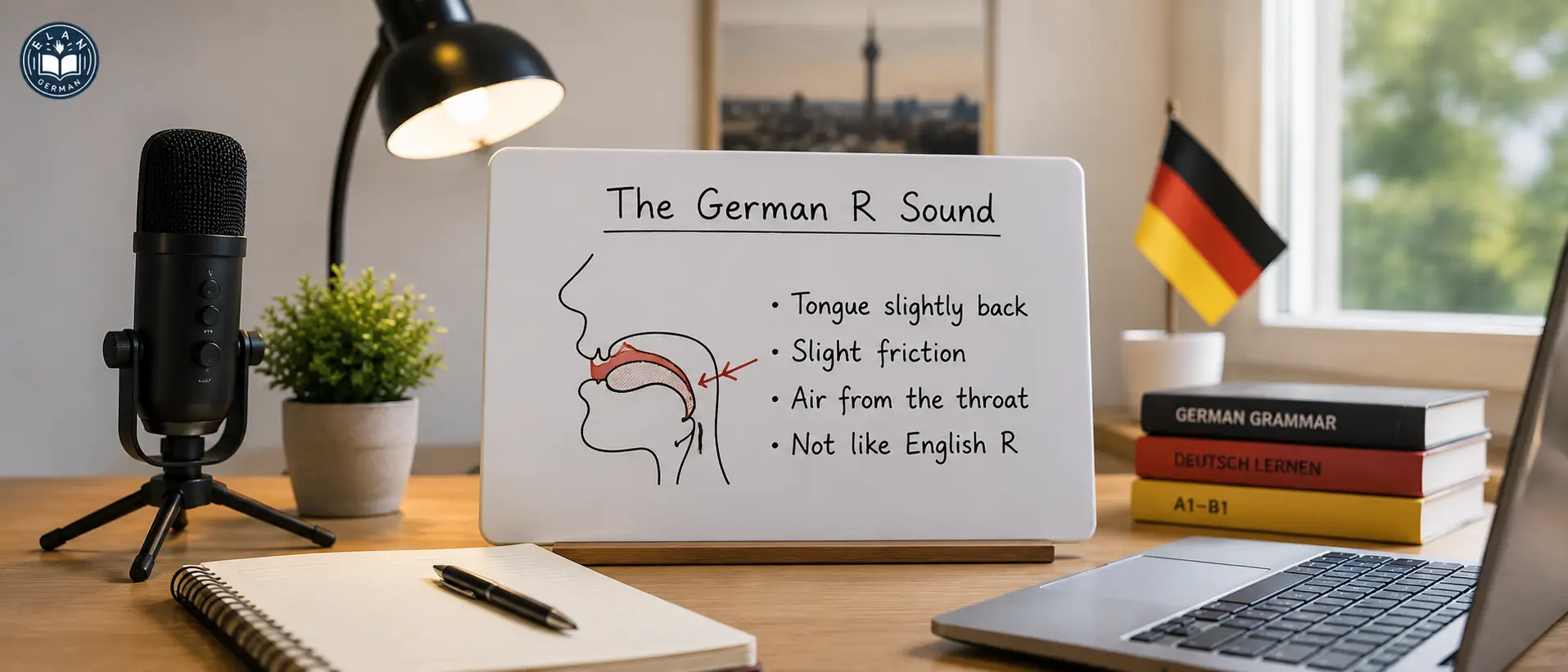
German R Sound Pronunciation Guide: Not English or French
German r sound pronunciation comes down to a uvular sound, produced by vibrating the very back of the tongue against the soft palate near the uvula, closer to a soft gargle than the tapped R used in English or the harsher, more guttural R used in French. Many learners default to one of those two substitutes out of habit, but neither quite matches. At the end of a word or syllable, German R often softens even further into something closer to a vowel sound, almost disappearing, which is why words like "Vater" sound less like "faTER" and more like "faTA" in relaxed speech. This page breaks down the throat position needed and compares all three languages' R sounds directly, building on the umlaut pronunciation guide already on the site.
Getting german r sound pronunciation right matters more than most learners expect, because the R appears constantly, in numbers, in verb endings, in common words like wir, sehr and warum. A shaky R does not stop you from being understood, but it is one of the fastest signals a native ear picks up when judging how comfortable you are in the language, right alongside the rhythm of your filler words in casual conversation.
German R Sound Pronunciation vs English R vs French R
English R
A tapped or approximant sound made with the tongue tip near the roof of the mouth, without touching, and no throat vibration involved at all.
French R
A stronger, more guttural sound produced further back in the throat, often with more friction and a harsher quality than the German version.
German R
A softer uvular sound, more like a gentle gargle, produced by the back of the tongue vibrating lightly near the uvula, without the harsher friction of French.
Learners coming from English often substitute their native tapped R by habit, which sounds noticeably foreign to German ears. Learners with some French background sometimes overcorrect into a harsher sound than German actually uses. The German version sits somewhere between the two, softer than French, further back than English.
Dialect adds another layer worth knowing about. Standard German taught in classrooms and used on national broadcasts favors the soft uvular r german sound described here, but a rolled r german variant made with the tip of the tongue survives in parts of Bavaria, Austria and Switzerland, closer to the trilled R heard in Spanish or Italian. If a German speaking colleague or friend produces R differently from what you learned, they are almost certainly not wrong, they are simply using a regional variant rather than the standard broadcast pronunciation.
Some learners describe the target sound as a german throat sound r because the vibration sits so far back, closer to where you would feel a gentle gargle than anywhere near the teeth or lips. That description is a useful mental shortcut even if it is not phonetically precise, since it steers your tongue toward the right general area before you refine the exact position through practice.
Comparing recordings side by side helps more than any written description. Choose a short phrase with several R sounds, listen to a German news anchor, then a French speaker, then an English speaker say something similar, and notice how far back in the mouth each version is produced. Once your ear can tell the three apart reliably, your own production tends to improve quickly, since most learners are closer to the target than they think.
Anyone typing how to pronounce german r into a search bar is usually chasing a shortcut that does not exist, since the honest answer is repetition paired with careful listening. Framing the question as german r vs french r and german r vs english r rather than as an isolated sound helps too, because most learners already have a working uvular reflex from clearing their throat, they simply have never applied it to speech before.
The R Sound at the End of a German Word
At the end of a word or syllable, especially after a vowel, German R commonly softens into something closer to a schwa sound, almost vanishing rather than being fully pronounced. This is why "Vater" (father) sounds closer to "FAH tah" in natural speech, and why "wir" (we) often sounds closer to "veeah" than a fully pronounced final R. This part of german r sound pronunciation trips up learners who expect a rolled r german style consonant in every position.
| Word | Position | R Behavior |
|---|---|---|
| Reise (trip) | Start of word | Full uvular R |
| Vater (father) | End of word, after vowel | Softens toward a vowel sound |
| Brot (bread) | Consonant cluster | Full uvular R, blended with the following consonant |
| Uhr (clock) | End of word, after long vowel | Softens almost completely, barely audible |
| vor (before) | Whole word is the stressed syllable | Softens, similar pattern to Vater |
| Freund (friend) | After a consonant, start of word | Full uvular R |
A simple rule of thumb helps predict the pattern before you even hear a word out loud. If the R sits in front of a vowel, in Reise or rot for example, expect the full uvular consonant. If the R sits after a vowel at the end of a syllable, in Vater, Uhr or vor, expect it to soften toward a vowel like sound instead. Consonant clusters such as Brot or Freund keep the fuller consonant version because the R is doing real phonetic work between two other sounds rather than closing off a syllable on its own.
This is one reason german phonetics r sound rules feel inconsistent to beginners at first, even though native speakers apply the pattern automatically without ever learning it as a rule. Once you internalize the position based pattern, reading unfamiliar German words aloud becomes far less guesswork and far more pattern recognition.
Searching specifically for r sound at end of german word patterns is a smart move for intermediate learners, since this single rule resolves a large share of the pronunciation surprises that come up once vocabulary grows beyond the beginner stage. It also explains why so many German consonant sounds seem to soften near the end of a breath group, the same relaxed articulation that affects final R also touches other consonants spoken quickly in casual sentences.
Practice Tip
Try gargling water gently and noticing the back of the throat position, that same muscle area is roughly where the German uvular R is produced, minus the water. Practice with words that start with R, like "rot" (red) and "Reise" (trip), before moving to trickier end of word cases like "Vater" and "wir." Recording yourself and comparing against native audio remains the fastest way to improve your german r sound pronunciation and catch small inaccuracies your own ear might miss in the moment.
A short daily routine works better than one long session. Spend two minutes on isolated R sounds, two minutes reading short sentences packed with R, then two minutes repeating full phrases you might actually use, drawn from a resource like this guide to essential German phrases. Consistency across a few weeks builds the muscle memory faster than any single marathon practice session ever could.
Common mistakes worth watching for include swapping in the English R out of habit mid sentence, over rolling the R the way a Spanish or Italian R would sound, and dropping the R entirely even in positions where German keeps the full consonant. Recording a thirty second voice note once a week and comparing it to a native clip of the same words is often enough to catch all three problems early.
If the sound still will not come, isolate the guttural r pronunciation itself before returning to full words. Sit with your mouth slightly open, breathe out steadily, and let the very back of the tongue buzz lightly against the soft palate without engaging the throat muscles used for a hard cough. That gentle vibration, not force, is the whole secret behind how germans pronounce r, and treating german r sound practice as a quiet, relaxed habit rather than a forced effort tends to produce results faster.
Keep Practicing Your Pronunciation
How to Pronounce German Umlauts
Another mouth position challenge worth mastering early.
German Filler Words That Make You Sound Fluent
Pair clean pronunciation with the small words that make speech feel natural.
Essential German Phrases Guide
Practice the R sound inside phrases you will actually use day to day.
Du vs Sie, A Formality Guide
Round out your spoken German with the right level of formality too.
Learn German From Scratch
A full roadmap for building spoken German skills from the ground up.
FAQ: German R Sound Pronunciation Guide: Not English or French
How do you pronounce the German R sound?
As a soft uvular sound made by vibrating the back of the tongue near the uvula, softer than the French R and further back than the English R.
Is the German R the same as the French R?
No, the German R is generally softer and less guttural than the harsher, more forceful French R.
Why does R disappear in words like Vater?
At the end of a word or syllable, German R often softens into a vowel-like sound rather than being fully pronounced, especially in casual speech.
Can I use the English R when speaking German?
You will likely be understood, but it sounds noticeably foreign to native ears, so it is worth practicing the uvular version described in this German r sound pronunciation guide.
What is a good way to practice german r sound pronunciation?
Try gently gargling to feel the back of the throat position, then practice R at the start of words like rot and Reise before tackling trickier end-of-word cases.
Does every region in Germany pronounce R the same way?
There is some regional variation, and a rolled r German sound survives in parts of Bavaria, Austria, and Switzerland, but the standard uvular R described here is the most widely taught and recognized version.
Is the German R sound difficult for English speakers to learn?
It takes practice since English has no equivalent uvular sound, but most learners can produce a passable version within a few weeks of focused German pronunciation practice R drills.
Does german r sound pronunciation change depending on the word ending?
Yes, an R before a vowel stays a full consonant, while an R at the end of a syllable after a vowel typically softens toward a vowel-like sound instead.
Discover more from Elan German
Subscribe to get the latest posts sent to your email.




















One comment
[…] German R Sound Pronunciation Guide: Not English or French […]
Comments are closed.