
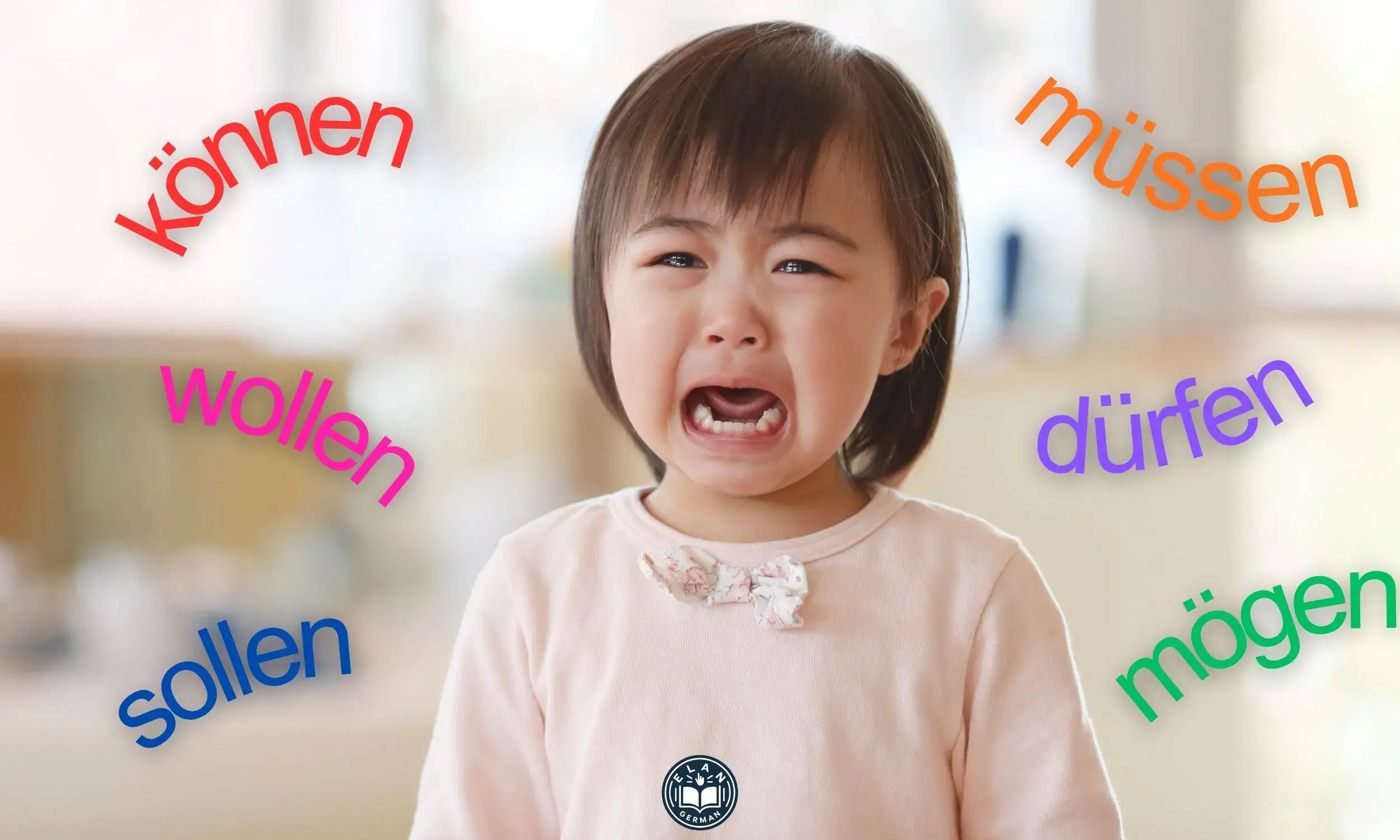
German Modal Verbs: können, müssen, wollen & More Explained
German modal verbs are a set of six verbs that express ability, necessity, permission, and desire. The six are können (can), müssen (must / have to), wollen (want to), dürfen (may / allowed to), sollen (should / supposed to), and mögen / möchten (like / would like to). The rule that ties all six together is simple: the modal verb takes position two in the sentence, and the main verb moves to the end as an infinitive. That one pattern, applied consistently across six verbs, unlocks a huge portion of everyday German conversation. If you are starting out or preparing for the A1 exam, these verbs are not optional.
What Are German Modal Verbs?
The golden rule that never changes: Modal verb in position 2. Main verb at the end as an infinitive.
Ich kann Deutsch sprechen. → I can speak German.
Sie müssen jetzt gehen. → They must go now.
Er will die Schlösser in Deutschland besuchen. → He wants to visit the castles in Germany.
The structure is fixed regardless of which modal verb you choose or how you conjugate it.
Modal verbs are called Modalverben in German. Unlike regular verbs, they have irregular present tense conjugations and drop their umlaut in singular forms (ich, du, er/sie/es). Getting comfortable with German pronouns first makes the conjugation tables in this post much easier to follow. For broader grammar context, our German Grammar Rules post builds on these foundations.
All 6 German Modal Verbs at a Glance
| Modal Verb | Core Meaning | When to Use It | Quick Example |
|---|---|---|---|
| können | can / be able to | Ability or possibility | Ich kann schwimmen. I can swim. |
| müssen | must / have to | Necessity or obligation | Du musst lernen. You have to study. |
| wollen | want to | Intention or desire | Er will kommen. He wants to come. |
| dürfen | may / be allowed to | Permission | Hier darf man parken. You may park here. |
| sollen | should / supposed to | Expectation or instruction | Du sollst ruhig sein. You should be quiet. |
| mögen / möchten | like / would like to | Preference or polite request | Ich möchte Kaffee. I would like coffee. |
These verbs appear at A1 level and stay essential all the way to B2 and beyond. Before going further, check how ready you already are with our free German A1 online test.
können and müssen: Ability and Obligation
These two are the ones you will reach for most in daily life. können covers what you are able to do or what is possible. müssen covers what you must do or are obligated to do. Both follow the same pattern: the umlaut drops in the ich and er/sie/es forms, making the first and third person singular identical. That is a pattern you will see across all six modal verbs.
können
can / to be able to
| ich | kann |
| du | kannst |
| er / sie / es | kann |
| wir | können |
| ihr | könnt |
| sie / Sie | können |
müssen
must / have to
| ich | muss |
| du | musst |
| er / sie / es | muss |
| wir | müssen |
| ihr | müsst |
| sie / Sie | müssen |
können: Kannst du mir helfen? (Can you help me?)
können: Wir können morgen kommen. (We can come tomorrow.)
können: Sie kann sehr gut kochen. (She can cook very well.)
müssen: Ich muss früh aufstehen. (I have to get up early.)
müssen: Ihr müsst die Hausaufgaben machen. (You all have to do the homework.)
müssen: Er muss arbeiten. (He has to work.)
A common beginner error is putting the modal verb at the end. Ich Deutsch sprechen kann is wrong. The correct order is always: Ich kann Deutsch sprechen. For more patterns like this, read our post on common German mistakes beginners make.
wollen and dürfen: Desire and Permission
wollen expresses what you want or intend to do. Germans use it constantly when talking about plans, goals, and preferences. dürfen is about permission — whether something is allowed or not. You see dürfen most on signs, in rules, and in instructions. Both verbs lose their umlaut in singular forms, just like können and müssen.
wollen
want to / intend to
| ich | will |
| du | willst |
| er / sie / es | will |
| wir | wollen |
| ihr | wollt |
| sie / Sie | wollen |
dürfen
may / to be allowed to
| ich | darf |
| du | darfst |
| er / sie / es | darf |
| wir | dürfen |
| ihr | dürft |
| sie / Sie | dürfen |
wollen: Ich will nach München fahren. (I want to go to Munich.)
wollen: Was willst du werden? (What do you want to become?)
wollen: Sie wollen ein Haus kaufen. (They want to buy a house.)
dürfen: Darf ich reinkommen? (May I come in?)
dürfen: Hier darf man nicht rauchen. (You are not allowed to smoke here.)
dürfen: Die Kinder dürfen heute länger aufbleiben. (The children are allowed to stay up later today.)
Watch out: ich will does NOT mean "I will" as in the English future tense. It means "I want to." This trips up English speakers constantly. For real travel situations where wollen and dürfen show up naturally, our German travel phrases post has practical examples ready to use.
sollen and mögen / möchten: Expectation and Preference
sollen is the verb of external obligation — someone told you to do it. Your boss, a teacher, a rule. If the obligation comes from inside yourself, you use müssen. If it comes from someone else, sollen is the right choice. mögen covers general liking, but its companion möchten (would like to) is the one you will hear and use far more often, particularly in shops, restaurants, and polite requests.
sollen
should / supposed to
| ich | soll |
| du | sollst |
| er / sie / es | soll |
| wir | sollen |
| ihr | sollt |
| sie / Sie | sollen |
mögen
like / to like
| ich | mag |
| du | magst |
| er / sie / es | mag |
| wir | mögen |
| ihr | mögt |
| sie / Sie | mögen |
sollen: Du sollst um 8 Uhr da sein. (You are supposed to be there at 8.)
sollen: Sie sollen bitte leise sein. (They should please be quiet.)
sollen: Was soll ich tun? (What am I supposed to do?)
mögen: Ich mag Kaffee. (I like coffee.)
mögen: Er mag keine Zwiebeln. (He does not like onions.)
möchten (would like to) — the polite everyday form
möchten is not the present tense of mögen. It is a separate subjunctive form that functions as its own modal verb in spoken German. Conjugation: ich möchte · du möchtest · er/sie/es möchte · wir möchten · ihr möchtet · sie/Sie möchten.
Ich möchte einen Kaffee bitte. (I would like a coffee please.)
Wir möchten heute Abend ins Kino gehen. (We would like to go to the cinema tonight.)
Talking about family in German? Verbs like mögen and wollen come up naturally in family conversations. Build your vocabulary first with our German family members post, then combine it with the modal verbs you now know.
Get the Free German A1 Book — Includes Modal Verbs
Modal verbs make much more sense when you practice them with structured exercises. Our free A1 book covers all six modal verbs with conjugation drills, sentence-building tasks, and vocabulary lists for beginners.
- All 6 modal verbs with conjugation tables and exercises
- A1 vocabulary, articles, pronouns, and grammar rules
- Real practice sentences for everyday situations
- 100% free PDF — no signup needed
German Modal Verbs in Real Sentences
Conjugations become useful only when you see them in context. The table below pairs each modal verb with sentences you can adapt immediately. Notice that the main verb always ends the sentence regardless of what comes before it.
| German Sentence | Modal Verb | English Meaning |
|---|---|---|
| Ich kann gut kochen. | können | I can cook well. |
| Kannst du mir bitte helfen? | können | Can you help me please? |
| Wir müssen morgen früh aufstehen. | müssen | We have to get up early tomorrow. |
| Du musst jetzt gehen. | müssen | You must go now. |
| Ich will nach München fahren. | wollen | I want to go to Munich. |
| Sie will Ärztin werden. | wollen | She wants to become a doctor. |
| Darf ich die Tür öffnen? | dürfen | May I open the door? |
| Hier darf man nicht parken. | dürfen | You are not allowed to park here. |
| Du sollst pünktlich sein. | sollen | You are supposed to be on time. |
| Was soll ich jetzt tun? | sollen | What am I supposed to do now? |
| Ich möchte einen Tee bitte. | möchten | I would like a tea please. |
| Wir möchten das Museum besuchen. | möchten | We would like to visit the museum. |
Many of these sentences involve time words like morgen (tomorrow) or jetzt (now). To get fluent with German time language, our German time expressions post is a natural follow-up. And for modal verbs in travel contexts — ordering, asking directions, checking permissions — our German travel phrases post is the practical application.
5 Things to Remember About German Modal Verbs
Position 2. Always.
The modal verb stays in position 2. The infinitive goes to the end. This rule applies across all six verbs without exception.
Umlaut Drops in Singular
ich kann, er muss, sie will. The umlaut only comes back in plural: wir können, ihr müsst, sie wollen. Check the tables above to confirm each one.
ich will ≠ I will
ich will means "I want to" — not the English future tense. This is the most common false friend with modal verbs for English speakers.
möchten Over mögen
Use möchten when ordering or requesting something politely. Ich möchte einen Kaffee sounds correct and natural. Ich mag einen Kaffee in that context does not.
müssen vs sollen
Self-imposed obligation uses müssen. Someone told you to do it? Use sollen. Du sollst das Formular ausfüllen means an instruction came from outside you.
Keep Building Your German
Six Verbs. One Rule. A Lot of German Unlocked.
können, müssen, wollen, dürfen, sollen, and mögen cover ability, obligation, desire, permission, expectation, and preference. They follow consistent conjugation patterns and obey the same word order rule every single time. That predictability is rare in German grammar, take advantage of it.
Start with können and müssen since they appear most in A1 tasks and real conversation. Then add wollen and möchten. If you want a structured path through all of this with practice exercises included, download our free German A1 book and work through it at your own pace.
FAQ: German Modal Verbs: können, müssen, wollen & More Explained
What are German modal verbs?
German modal verbs are six verbs that modify another verb in a sentence. They express ability, necessity, desire, permission, or expectation. The six are können (can), müssen (must), wollen (want to), dürfen (may), sollen (should), and mögen/möchten (like/would like to).
How do you use a modal verb in a German sentence?
The modal verb always goes in position two. The main verb moves to the end as an infinitive. Example: Ich kann Deutsch sprechen. (I can speak German.) That structure applies to all six verbs without exception.
What is the difference between müssen and sollen?
müssen is for obligations that come from yourself or from necessity. sollen is for obligations that come from someone else. Ich muss lernen means you feel you need to study. Ich soll lernen means someone told you to.
What is the difference between mögen and möchten?
mögen expresses general liking; Ich mag Kaffee means I like coffee. möchten means ‘would like to’ and is used for polite requests in the moment; Ich möchte einen Kaffee, bitte. In daily conversation, möchten is the one you will use far more.
Does "ich will" mean "I will" in German?
No. This is the most common false friend for English speakers. Ich will means I want to, not the English future tense. Ich will kommen means I want to come, not I will come.
Are modal verbs part of the Goethe A1 exam?
Yes. können, müssen, wollen, and möchten all appear at the A1 level in reading, listening, and writing tasks. Knowing their conjugations and the word order rule is enough to handle them confidently in the exam.
Discover more from Elan German
Subscribe to get the latest posts sent to your email.